From vehicles to wildlife: transferable deep learning for trajectory generation

From vehicles to wildlife: transferable deep learning for trajectory generation
Patras, J.; Fablet, R.; Brunel, A.; Roy, A.; Bugoni, L.; Tavares Nunes, G.; Barbraud, C.; Jacoby, J.; Benboudjema, S.; Passuni, G.; Delord, K.; Lanco, S.
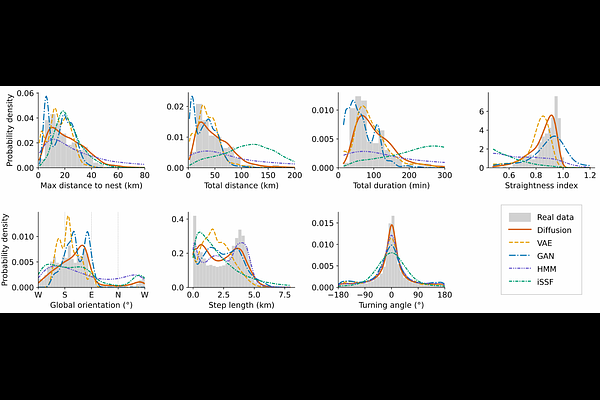
AbstractRealistic simulation of animal movement is fundamental to conservation, habitat modeling, and ecological scenario evaluation. Traditional approaches struggle to capture multi-scale trajectory dynamics, while generative deep learning for complete trajectory simulation remains largely unexplored in ecology due to data scarcity. We show that a diffusion model pre-trained on millions of vehicle GPS trajectories can be fine-tuned on hundreds of seabird central-place foraging trips to simultaneously generate ecologically realistic trajectories for five species and six breeding colonies. The fine-tuned model consistently outperforms four state-of-the-art baselines (GAN, VAE, HMM, iSSF) across movement metrics spanning step dynamics, spatial distribution, and behavioral temporality, with comparable or shorter computation times. Domain transfer reaches full performance in 35 minutes versus 7 hours from scratch, and conditioning on species and colony enables generalization to unseen combinations from as few as 10 trajectories. These results establish cross-domain transfer learning as a new paradigm for data-efficient generative animal movement modeling.