Evolution of the highest fidelity DNA replication systems

Evolution of the highest fidelity DNA replication systems
Baehr, S.; Call, C.
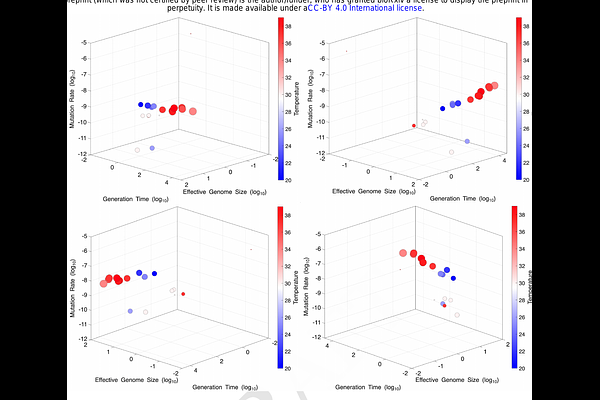
AbstractDNA mutation on average is deleterious, and evolution generally acts to reduce mutation rates to the limit of natural selection. The limit of natural selection is set by multiple factors, of which effective population size is only one. We consider a form of lethal mutagenesis as an upper bound to mutation rates for any organism, an argument that is congruent with a biophysical context, wherein random mutations are a form of entropy. In this analysis, coding genome size, body mass, generation time, and temperature explain more than 90% of the variation in mutation rate per generation across the Tree of Life. The organisms with larger genomes, longer lifespans and relatively larger body sizes, known and unknown, represent the lineages which have likely evolved novel mechanisms to lower mutation rates. Though these variables are largely shared by Peto's Paradox, this selective pressure occurs through germline mutation rate evolution rather than the soma.