Inflammatory suppression and cancer-associated bypass of the b0,+selenium-utilization program in the human intestine

Inflammatory suppression and cancer-associated bypass of the b0,+selenium-utilization program in the human intestine
He, X.; Zhong, K.; Pu, Y.; Hu, H.; Du, Y.; Chen, X.; Chen, L.
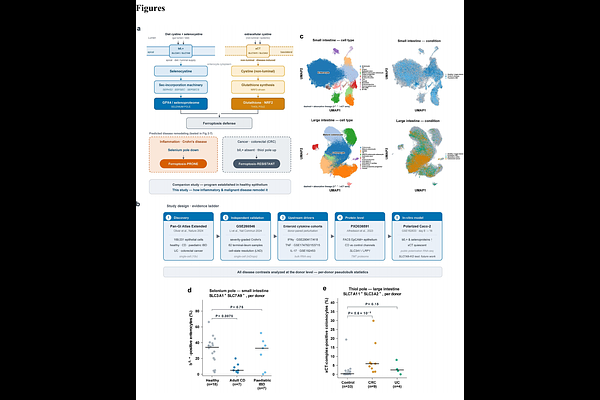
AbstractThe b0,+ transporter (SLC3A1/SLC7A9) imports cystine and selenocystine at the enterocyte apical membrane and defines a selenium-utilization program in the healthy human intestine (He et al., bioRxiv 2026); how this program is altered in disease is unknown. Using a multi-cohort single-cell framework with donor-level statistics, we find that inflammation and cancer remodel a single epithelial redox-currency axis in opposite directions. In adult Crohn's disease, b0,+ co-expression in small-intestinal enterocytes was suppressed (median 4.9% vs 34% positive; P = 0.008) but preserved in paediatric IBD; this loss reflected replacement of b0,+ -high mature enterocytes by a dedifferentiated state rather than transcriptional disruption, with the SLC7A9-SELENOP coupling intact. Downstream, GPX4 alone was selectively suppressed while the selenocysteine-incorporation machinery was preserved, priming the epithelium for ferroptosis in a severity-graded manner. Inflammatory cytokines (IFN{gamma}, TNF) suppressed the selenium pole in small-intestinal enteroids, and a network knockout indicated that b0,+ supports the selenoproteome through substrate supply rather than transcriptional control; an independent patient proteome and a Caco-2 polarization model corroborated the axis. Colorectal-cancer colonocytes showed the opposing pole, near-absent b0,+ with induction of the xCT/thiol program (P = 5.6 x 10 -5) and a ferroptosis-resistant configuration. Thus b0,+ marks the supply node of a dual-pole selenium-thiol axis: inflammation collapses the selenium pole toward a ferroptosis-prone dedifferentiated state, whereas cancer bypasses it toward an xCT antioxidant pole. The baseline axis state is an exploratory correlate of anti-TNF response and a candidate point of disease-associated vulnerability.