The basal cell state maintains pancreatic cancers by controlling an immunosuppressive circuit

The basal cell state maintains pancreatic cancers by controlling an immunosuppressive circuit
Singhal, A.; Ryan, K.; Rose, S.; Styers, H.; Kim, J.; Pasnuri, N.; Moore, A.; Llamosas, J.; Chen, E.; Adams, J.; Nandula, A.; Sharma, R.; Li, Z.; Nawy, T.; Yan, Y.; Tezcan, N.; Basturk, O.; Sherman, M. H.; Pe'er, D.; Tammela, T.
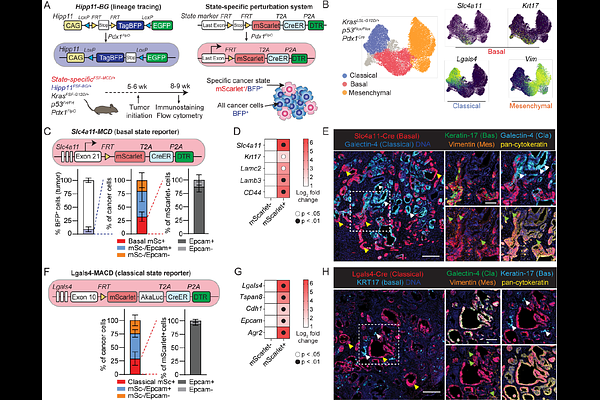
AbstractIntra-tumoral heterogeneity is a cardinal feature of solid tumors, yet how distinct cancer cell states functionally contribute to malignant and stromal diversity in situ remains poorly understood. Using mouse models to lineage-trace or genetically ablate the two predominant cancer cell states in autochthonous pancreatic ductal adenocarcinoma (PDAC), we discover that basal cancer cells are highly plastic, whereas classical cancer cells exhibit limited plasticity. Strikingly, ablation of the basal, but not the classical, state induced rapid and durable tumor collapse, driven by loss of immunosuppressive cancer-associated fibroblasts, macrophage repolarization, and reprogramming of the tumor cytokine milieu, culminating in tumor destruction by cytotoxic lymphocytes. Knockout of a single cytokine, GM-CSF, specifically in basal cells recapitulated macrophage repolarization and lymphocyte recruitment observed upon basal state ablation and shrank tumors. These results reveal the basal cell state controls an immunosuppressive cell circuit critical for PDAC maintenance, motivating therapeutic targeting of the basal cells.