Leveraging multiplicity in biologically informed neural networks to uncover disease heterogeneity

Leveraging multiplicity in biologically informed neural networks to uncover disease heterogeneity
Gankin, D.; Beltrao, P.
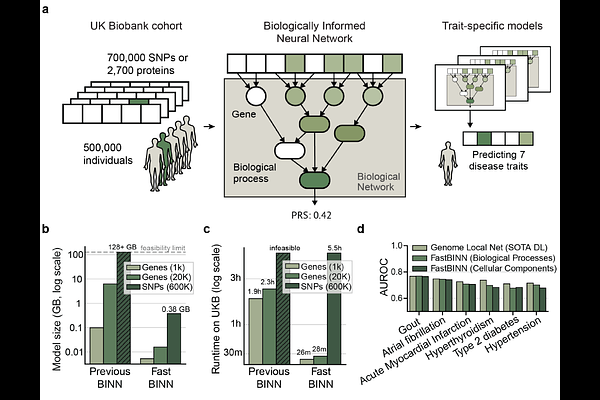
AbstractBiologically inspired neural networks (BINNs) embed pathway, ontology, or protein-interaction structure directly into neural networks, promising interpretable disease prediction where hidden nodes map to named biological entities. Yet BINNs have been hard to train at biobank scale, and the reliability of their interpretations remains largely untested. Here we present a fast BINN implementation trained on UK Biobank genotype and plasma proteomics data from about 500,000 individuals across six common diseases. BINNs achieve competitive predictive performance, but we uncover two major limits to their interpretability. First, attribution scores are strongly biased by graph topology, because node degree and layer position influence the scores. Normalization reduces this bias but can weaken enrichment for known disease genes. Second, BINNs show substantial predictive multiplicity, that is, independently trained models with identical architecture and data reach similarly accurate solutions while prioritizing different genes and pathways. Although this multiplicity makes single-model explanations unstable, the range of interpretations can itself reveal disease biology. Across 100 replicate BINNs for type 2 diabetes, we find distinct solution clusters prioritizing either inflammatory or hepatic-metabolic pathways, mirroring known disease heterogeneity. Thus, analyzing the space of BINN explanations can turn multiplicity into a tool for studying complex disease mechanisms.