RankMap: Rank-based reference mapping for fast and robust cell type annotation in spatial and single-cell transcriptomics

RankMap: Rank-based reference mapping for fast and robust cell type annotation in spatial and single-cell transcriptomics
Cheng, J.; Li, S.; Kim, S.; Ang, C. H.; Chew, S. C.; Chow, P. K.-H.; Liu, N.
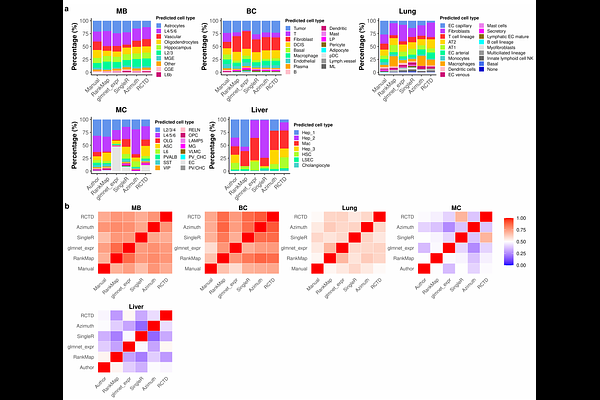
AbstractAccurate cell type annotation is essential for the analysis of single-cell and spatial transcriptomics data. While reference-based annotation methods have been widely adopted, many existing approaches rely on full-transcriptome profiles and incur substantial computational cost, limiting their applicability to large-scale spatial datasets and platforms with partial gene panels. Here, we present RankMap (https://github.com/jinming-cheng/RankMap), an efficient and flexible R package for reference-based cell type annotation across both single-cell and spatial transcriptomics. RankMap transforms gene expression profiles into rank-based representations using the top expressed genes per cell, improving robustness to platform-specific biases and expression scale differences. A multinomial regression model trained with elastic net regularization is then used to predict cell types and associated confidence scores. We benchmarked RankMap on five spatial transcriptomics datasets, including Xenium, MERFISH, and Stereo-seq, as well as two single-cell datasets, and compared it with established methods such as SingleR, Azimuth, and RCTD. RankMap achieved competitive or superior annotation accuracy while consistently reducing runtime compared to existing methods, particularly for large spatial datasets. These results demonstrate that RankMap provides a scalable and robust solution for reference-based cell type annotation in modern single-cell and spatial transcriptomics studies.