A transcriptional signature of LKB1 functional loss defines a large, therapeutically addressable patient population across human cancers

A transcriptional signature of LKB1 functional loss defines a large, therapeutically addressable patient population across human cancers
Bandyopadhyay, S.; Gordan, J.
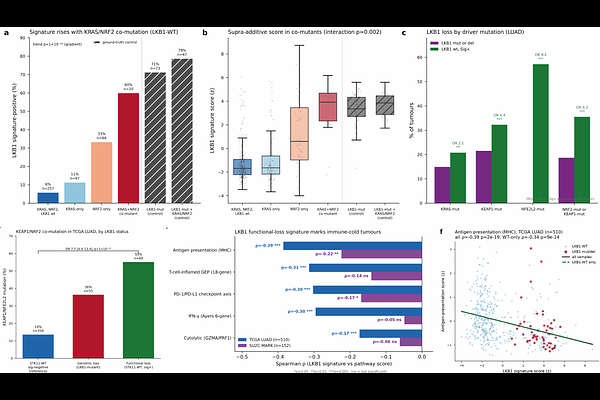
AbstractLoss of the tumor suppressor LKB1 (STK11) drives metabolic reprogramming and immune evasion, but its clinical footprint is defined almost entirely by somatic mutation and deletion. Because emerging therapies aim to reactivate this pathway in structurally wild-type tumors, defining the full LKB1-deficient population (including tumors silenced by non-genomic mechanisms) is a prerequisite for patient selection. We derived a 30-gene transcriptional signature of LKB1 functional loss, training on genomically-defined STK11 loss in lung adenocarcinoma and validating in an independent squamous cohort (AUROC 0.926). It transferred to four independent non-TCGA LUAD cohorts (AUROC >0.92), outperforming the published Kaufman 16-gene classifier. Critically, restoring wild-type LKB1 in LKB1-mutant NSCLC lines reversed the signature while a kinase-dead mutant did not, establishing that it reads out LKB1 kinase function, not merely mutation status. Applied pan-cancer, the signature identified functional LKB1 loss in wild-type tumors at 7.2%, expanding total LKB1-loss prevalence 3.7-fold over genomic loss alone (2.7% [->] 9.9%), largest in esophageal, colorectal, endometrial and cutaneous cancers. This population is decoupled from LKB1 mutation and deletion frequency, yet enriched in BRAF-mutant colorectal (25% signature-positive) and HER2-amplified breast (21% signature-positive) cancers: readily-testable subgroups for screening. In lung adenocarcinoma, signature positivity rose across a co-mutation gradient from 6% background to 15% in KRAS-mutant, 35% in NRF2-pathway-mutant (KEAP1 or NFE2L2), to 64% in KRAS/NRF2 co-mutant tumors. Similar to KRAS/LKB1 co-mutant tumors, LKB1 wild-type but signature-high tumors were immune-cold, correlating negatively with antigen-presentation, interferon-{gamma} and T-cell-inflamed programs in multiple independent lung cancer cohorts. These results define a broad set of tumors with LKB1 functional loss that may open up new avenues for precision therapeutics.