Gut microbiome derived folate metabolite suppresses colorectal cancer progression

Gut microbiome derived folate metabolite suppresses colorectal cancer progression
Danner, R.; Cho, J.; Detwiler, Z.; Williams, J.; Han, J. A.; Yang, C.; Diebold, X.; Maeder, K.; Van Vraken, J. G.; Walker, A. S.; Lesser, C.; Chaudhari, S. N.
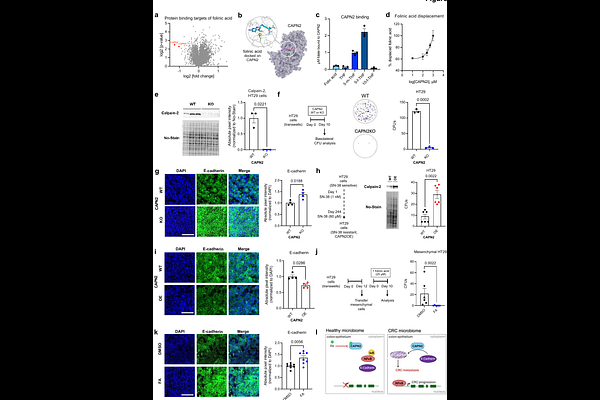
AbstractThe gut microbiota influences colorectal cancer (CRC) progression, primarily through the secretion of small molecule metabolites. While numerous microbial products are known to drive CRC, endogenous protective mechanisms remain largely uncharacterized. Utilizing a folate metabolomics platform, we demonstrate that the healthy gut microbiota produces folinic acid (FA), a known chemotherapeutic adjuvant also known as leucovorin. This microbially derived folinic acid is progressively depleted in mouse models of colitis-associated CRC and in human clinical metagenomic cohorts with advancing disease severity. Mechanistically, folinic acid acts as a signaling molecule that directly binds and inhibits the intracellular protease calpain-2. This interaction stabilizes epithelial E-cadherin protein expression and suppresses CRC epithelial-to-mesenchymal transition driving metastasis. Genetically manipulating gut microbial production of FA is sufficient to modulate CRC in vivo, even in the presence of chronic inflammation. This study reframes folinic acid from a chemotherapeutic enhancer to an endogenous microbial metabolite that actively suppresses CRC progression.