Spatiotemporal and demographic effects on avian malaria prevalence in blue tits

Spatiotemporal and demographic effects on avian malaria prevalence in blue tits
Theodosopoulos, A. N.; Andreasson, F.; Jönsson, J.; Nilsson, J.; Nord, A.; Raberg, L.; Stjernman, M.; Torres Lara, A. S.; Nilsson, J.-A.; Hellgren, O.
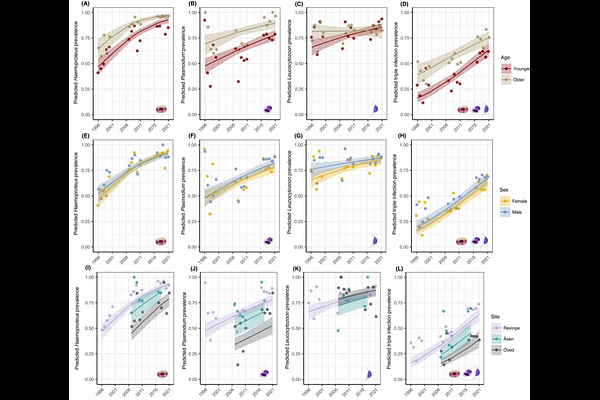
AbstractWhile the ubiquity of parasites is well understood, the extent to which host demographic factors shape parasite prevalence patterns merits further investigation. Using 15 years of breeding data from blue tits (Cyanistes caeruleus) in southern Sweden, spanning a 26-year timeframe, we assessed the roles of host age, sex, and field site on the odds of infection with three avian malaria parasite genera: Haemoproteus, Plasmodium, and Leucocytozoon. Further, we also evaluated the effects of these demographics on the odds of triple-genus coinfections. We found first-year breeders have fewer infections with Haemoproteus and Plasmodium, and fewer triple infections compared to older age classes, suggesting that birds are accumulating infections over time. Leucocytozoon infections are more prevalent in males than in females, and this may be due to sex-specific differences in physiology. The prevalence of malaria parasites and their coinfections also vary between the three sampling sites, indicative of an effect of host breeding habitat, even at a relatively small spatial scale (neighboring sites were separated by <5km). Across all three field sites, prevalence is overall significantly increasing over time. For Haemoproteus, this increase is more pronounced in older birds compared to younger birds. Such temporal changes in age-related infection patterns would not have been apparent without long-term data thus highlighting the importance of long-term studies for informing our understanding of host demographic effects on parasite prevalence.