multiScaleAC: Cell-Cell interaction with Moran's I as a function of kernel bandwidth

multiScaleAC: Cell-Cell interaction with Moran's I as a function of kernel bandwidth
Soupir, A. C.; Hayes, M. T.; Manley, B. J.; Wang, X.; Wrobel, J.; Peres, L. C.; Fridley, B. L.
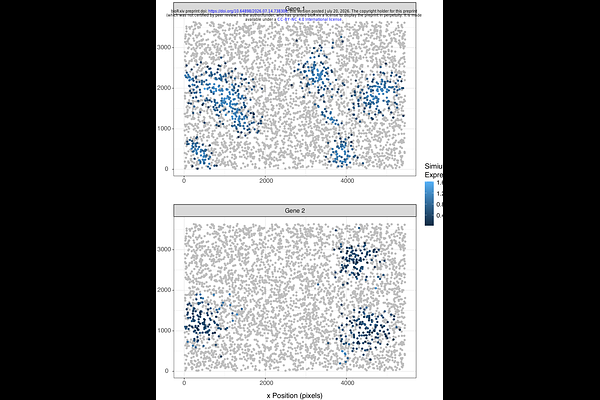
AbstractOver the last decade, spatial transcriptomic technology has transformed our understanding of tissue architecture including cell-cell interactions within the tumor immune microenvironment. A specific use-case of increasing interest is leveraging the spatial statistical relationship of genes whose protein products are known to be involved in ligand-receptor interactions. One methodological limitation of this approach has been the requirement to choose one radius around a cell as a parameter that can come with selection biases. Rather, interactions between cells vary in strength across a range of spatial scales that single-radius choice may miss. To fill this gap we developed `multiScaleAC` to extended Moran's I, a correlation measure that accounts for locations of values, by employing a Gaussian kernel applied to locations and varying the bandwidth parameter h. The resulting Moranis I\left(h\right) then can be compared between samples using functional data analysis. In the current study, we used simulations to show that our framework has well controlled Type I error due to the use of permutations for assessing significant interactions. We also demonstrate that `multiScaleAC` has high statistical power to identify a significant interaction when a true interaction is simulated (1.00 at bandwidths greater than 5) and increasing power as bandwidth increases when negative interaction is simulated. We found `multiScaleAC` largely captures similar significant ligand-receptor profiles in 8 Visium samples of colon tissue using the same bandwidth as `spatialDM` but without removing low-weight spots from the weight matrix (73.7% - 87.2%). Applying the `multiScaleAC` framework to our previous single-cell spatial transcriptomics data (COL4A1-ITGAV in the stromal compartment of clear cell renal cell carcinoma) followed by functional principal component analysis, we found functional principal component 1 to represent global interaction elevation/depression. Associating functional principal component 1 scores with immunotherapy exposure showed significantly higher scores in stromal tissues exposed to immunotherapy than those naive to immunotherapy, indicating an overall higher interaction of cell expressing COL4A1-ITGAV. These findings recapitulate our previous study while reducing bias in neighbor selections. We believe this is the first study to apply a functional extension of Moran's I in combination with functional data analysis to understand cell-cell interaction over spatial scales.