Septins promote breast cancer cell invasion in 3D collagen gels by influencing actin-based protrusion formation

Septins promote breast cancer cell invasion in 3D collagen gels by influencing actin-based protrusion formation
van der Net, A.; Beslmueller, K.; van Vliet, N.; Tavasso, M.; Beerens, M.; Boot, R. C.; Boukany, P. E.; Danen, E. H. J.; Koenderink, G. H.
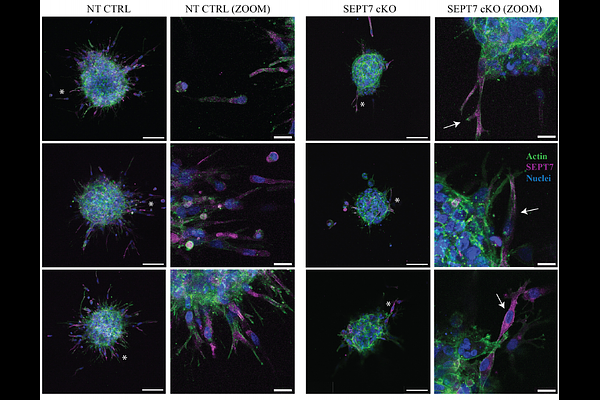
AbstractSeptins are cytoskeletal proteins that contribute to essential cellular processes such as cell migration and cell division through interactions with the cell membrane and the cytoskeleton. High expression of septins is correlated with breast cancer malignancy and promotes cell invasion, but the molecular complexity of septins interactions has made it challenging to dissect the underlying molecular mechanisms. Here, we used a conditional knockout approach to deplete SEPT7 in the metastatic triple-negative breast cancer cell line Hs578T and examined the role of septin in 3D-matrix invasion of breast cancer cells. We show by spheroid assays that SEPT7 deletion strongly impairs breast cancer cell invasion into collagen gels. Additional single-cell migration studies using 3D collagen gels and microfluidic pillar devices that mimic the pores present in collagen matrices showed that SEPT7 expression regulates confined cell migration through control of cell shape and actin-based protrusions.