Binding to Albumin and Off-Target Toxicity Confound the Use of LRRC8/VRAC Channel Blockers in Cell Physiology Assays

Binding to Albumin and Off-Target Toxicity Confound the Use of LRRC8/VRAC Channel Blockers in Cell Physiology Assays
Boulos, M. A.; Afghan, A. M.; Rudkouskaya, A.; Fidaleo, A. M.; Khan, M. T.; Sidhu, H. S.; Mongin, A. A.
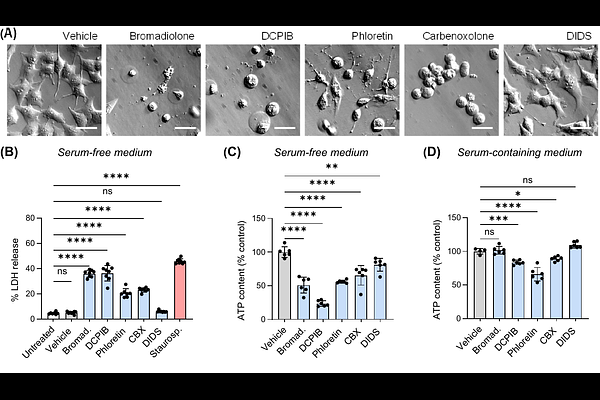
AbstractVolume-regulated anion channels (VRACs), formed by leucine-rich repeat-containing 8 (LRRC8) proteins, are ubiquitously expressed chloride channels essential for cell volume regulation and implicated in diverse physiological and pathological processes. Small-molecule VRAC inhibitors have been reported to modulate paracrine signaling, proliferation, differentiation, migration, and apoptosis, and have been patented for potential therapeutic applications in stroke, cardiovascular and metabolic diseases, and cancer. However, growing evidence indicates that many commonly used VRAC blockers exert substantial off-target effects and frequently fail to reproduce phenotypes observed after deletion of the essential VRAC subunit LRRC8A. Here, we systematically compared effects of several widely used pharmacological VRAC inhibitors with outcomes of molecular downregulation of LRRC8A in limiting proliferation of malignant glioblastoma cells derived from surgical specimens. NIH/3T3 fibroblasts served as a non-malignant control. In serum-containing media, structurally diverse VRAC blockers (DCPIB, DIDS, carbenoxolone, phloretin, and bromadiolone) reduced proliferation in a non-uniform manner, with potencies that did not correlate with reported VRAC affinities and varied markedly among cell lines. Radiotracer-based measurements of VRAC activity indicated that these discrepancies were largely attributable to binding of inhibitors to serum albumin. When experiments were repeated under serum-free conditions, all inhibitors except DIDS and phloretin induced extensive death of both malignant and non-malignant cells, confirmed by microscopy and LDH release assays. This cytotoxicity was accompanied by a marked reduction in intracellular ATP levels, consistent with previously reported mitochondrial uncoupling effects. In contrast, LRRC8A knockdown reduced proliferation without substantial cell death. Together, these findings demonstrate that most commercially available VRAC blockers limit proliferation and viability predominantly through VRAC-independent mechanisms. Under standard culture conditions, serum albumin masks much of their intrinsic cytotoxicity. These results underscore the need for rigorous molecular controls in pharmacological studies and provide guidance for developing more selective and less toxic VRAC-targeting agents.