Stratified Immune Profiling Uncovers Prognostic Heterogeneity Beyond MYCN Amplification and Age in Neuroblastoma

Stratified Immune Profiling Uncovers Prognostic Heterogeneity Beyond MYCN Amplification and Age in Neuroblastoma
Magno, J. M.; Muzzi, J. C. D.; Resende, J. S. S.; Querne, L. B. P.; Alvarenga, L. M.; Cavalli, L. R.; Figueiredo, B. C.; Castro, M. A. A.
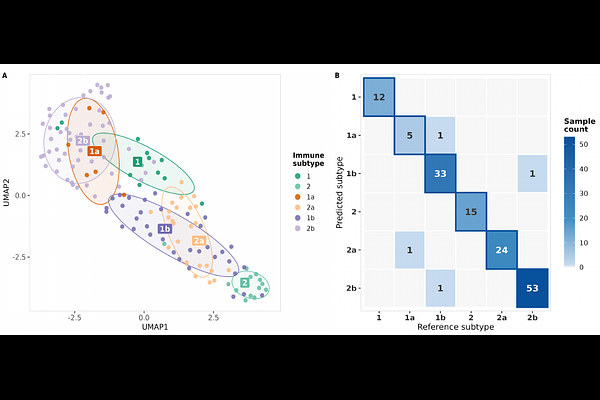
AbstractNeuroblastoma is the most common extracranial solid tumor in children, presenting remarkable clinical heterogeneity with survival outcomes ranging from spontaneous regression to aggressive progression. MYCN oncogene amplification and age at diagnosis are established prognostic factors that are typically treated as independent covariates in risk stratification, yet their joint influence on the tumor immune microenvironment remains poorly understood. Here we show that stratifying patients by both variables simultaneously reveals six reproducible immune subtypes with distinct transcriptional programs and prognostic significance. Consensus clustering of immunomodulatory gene expression profiles from 149 patients in the TARGET-NBL cohort identified subtypes whose survival trajectories differ significantly within clinical strata defined by MYCN status and age at diagnosis. A linear Support Vector Machine classifier trained on these subtypes, using immunomodulatory gene expression combined with MYCN amplification status and age at diagnosis as predictive features, achieved 97.2% accuracy and a Cohen's Kappa of 0.963 under 10-fold cross-validation, and generalized to an independent cohort of 493 patients (GSE62564). Kaplan-Meier analysis revealed significant survival differences across subtypes in both cohorts (TARGET-NBL: log-rank p = 0.0018; GSE62564: log-rank p < 0.0001). Single-sample gene set enrichment analysis identified differential activation of proliferative and immune response pathways across subtypes, consistent between both cohorts. These findings suggest that integrating MYCN amplification status and age at diagnosis as joint determinants of immune organization may reveal prognostic heterogeneity that is not fully captured when these factors are considered independently.