PREFERENTIAL INVASION OF DIFFERENTIATED BLADDER CARCINOMA CELLS BY FLAGELLATED GROUP B2 ESCHERICHIA COLI

PREFERENTIAL INVASION OF DIFFERENTIATED BLADDER CARCINOMA CELLS BY FLAGELLATED GROUP B2 ESCHERICHIA COLI
Hogins, J.; Nguyen, J.; Khuwaja, W.; Hall, S.; Fogg, V.; Dong, X.; Zimmern, P. E.; Reitzer, L.
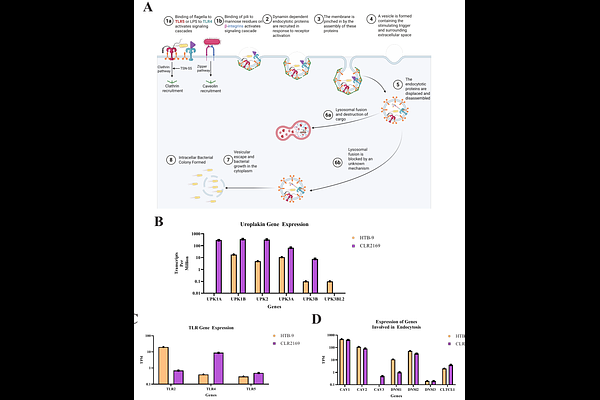
AbstractPhylogenetic group B2 Escherichia coli is associated with urinary tract infections and other pathologies, but the basis for this phylogenetic skew is not understood. One aspect of urinary tract infections is binding to and entering uroepithelial cells. To test whether a phylogenetic skew exists for cell invasion, we examined invasion of 10 E. coli strains from three phylogenetic groups into CRL2169 and HTB-9 cells, which are derived from grade 1 and grade 2 bladder carcinomas, respectively. The top four strains that invaded CRL2169 were from group B2: three of these strains had more flagella gene transcripts than the other seven strains. The seven strains that invaded HTB-9 were from different phylogenetic groups. For the model uropathogenic group B2 strain UTI89, which expresses pili over flagella, loss of flagella or pili impacted invasion into CRL2169 to similar extents, but loss of pili had a greater effect on invasion into HTB-9 and a murine infection model than loss of flagella. A hyperflagellated variant of a group A strain did not invade either cell line better than the parental strain. Reported transcript differences, which were confirmed experimentally, showed that CRL2169 was more differentiated. The endocytosis stimulator tanshinone enhanced invasion into HTB-9, but not into CRL2169, which suggests differences in endocytic pathways and is consistent with differences in differentiation states. If the initial or recurring event in urinary tract infection is invasion into differentiated urothelial cells, as opposed to tight junctions, then the role of flagella may have been underestimated.