Impact of the N-glycosylation on full-length IgG2 and IgG4 antibodies: a comparative study using molecular dynamics simulations.

Impact of the N-glycosylation on full-length IgG2 and IgG4 antibodies: a comparative study using molecular dynamics simulations.
LEON FOUN LIN, R.; Bellaiche, A.; Diharce, J.; Etchebest, C.
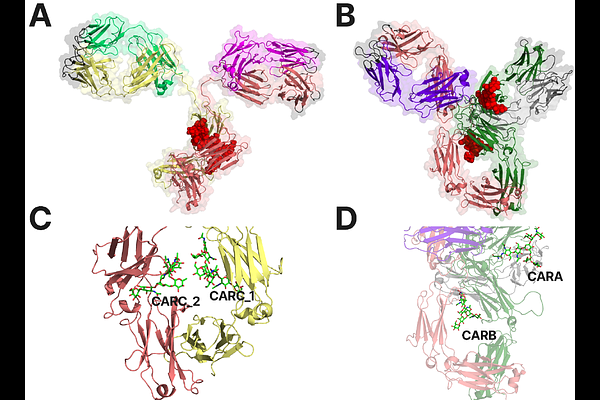
AbstractLike other proteins, monoclonal antibodies - important biodrugs- are subject to post translational modifications, especially the N-glycosylations. However, the effect of the N-glycosylations remains poorly studied and atomistic details about their influence are rarely available. . Moreover, the few existing studies focus on the prevalent immunoglobulin G1. To go further in the understanding of the impact of glycosylations, we have carried out a comparative exploration of the effect of N-glycosylations on two different classes of antibodies, namely Mab231, an IgG2 and the pembrolizumab, an IgG4 . The two antibodies differ by their sequences, their length, their 3D structure but also by the location and composition of the glycans. In the present work, detailed and important information were gained through molecular dynamics simulations where both monoclonal antibodies were studied without and with the presence of their glycans. The results of 1.5 microseconds of sampling for each system show that glycosylation does not drastically alter the overall conformational landscape of either antibody, whatever the metrics considered. However, it measurably modulates local flexibility, inter-domain correlated motions, and the relative orientation of the Fab arms with respect to the Fc domain, with statistically significant shifts in key geometric descriptors. Importantly, contact analysis reveals that glycan interactions extend beyond the Fc region to reach Fab residues. The allosteric network calculations demonstrate that the influence of Fc-bound glycans propagates even until the Fab framework regions in both mAbs, which could impact the antigen binding. The nature and magnitude of these effects are subclass-dependent, reflecting differences in glycan composition, hinge architecture, and three-dimensional organization Our findings challenge the prevailing view that Fc glycosylation uniformly promotes CH2 domain opening. More importantly, it underscores the necessity of considering full-length structures and IgG subclass diversity in glyco-engineering strategies.