Highly Accurate Estimation of the Fold Accuracy of Protein Structural Models

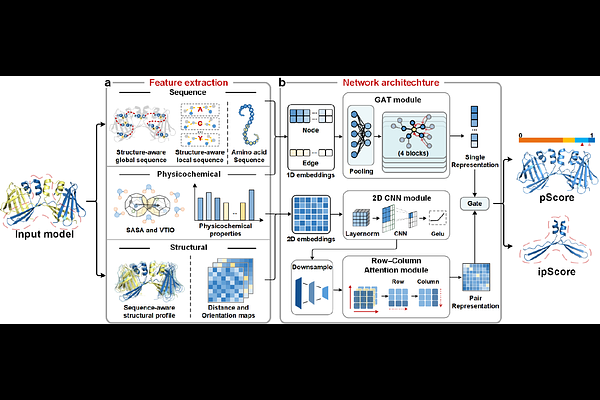
Highly Accurate Estimation of the Fold Accuracy of Protein Structural Models
Xie, L.; Ye, E.; Wang, H.; Zhang, T.; Zhen, Q.; Liang, F.; Liu, D.; Zhang, G.
AbstractThe function of a protein is intrinsically linked to its three-dimensional fold, and deep learning has revolutionized the field by enabling high-accuracy structure prediction at an unprecedented scale. Nevertheless, the growing deployment of these predictive pipelines in drug discovery and structural biology reveals a critical bottleneck that lies in the lack of independent and rigorous model accuracy estimation (EMA) methodologies. Here we present DeepUMQA-Global, a single-model deep learning framework for estimating accuracy of protein structural models. Our method employs a structure-sequence cross-consistency mechanism to quantify the bidirectional compatibility between the input sequence and the predicted three-dimensional structure, enabling a comprehensive characterization of fold accuracy. DeepUMQA-Global outperforms the self-assessment confidence scores of AlphaFold3, achieving improvements of 57.8% in the Pearson correlation and 49.0% in the Spearman correlation. With respect to the CASP16 retrospective benchmark, DeepUMQA-Global outperforms all single-model accuracy estimation methods that participated in CASP16 and achieves performance comparable to that of the top consensus-based methods. A lightweight consensus strategy built upon DeepUMQA-Global ranks first among all CASP16 participants, surpassing all other methods, including consensus approaches, and highlighting the strength of our method. Remarkably, DeepUMQA-Global demonstrates a strong ability to discriminate between alternative conformational states of proteins, as evidenced on the CASP unique alternative conformation protein complex target and the CoDNaS benchmark. Our results indicate that DeepUMQA-Global can be extended to broader protein modeling tasks, moving beyond static evaluation to offer a foundation for dynamic conformation EMA, where it accurately discriminates alternative conformational states and demonstrates reliable predictive fidelity in model accuracy estimation.