Chemokine-Dependent Natural Killer Cells Prevent Pulmonary Metastasis in a Newly Established Mouse Osteosarcoma Model

Chemokine-Dependent Natural Killer Cells Prevent Pulmonary Metastasis in a Newly Established Mouse Osteosarcoma Model
Yang, J.; Zindy, F.; Fields, S.; Hyle, J.; Janke, L. J.; Li, Q.; Xu, B.; Zhang, Q.; Wu, G.; Chang, T.-C.; Wierdl, M.; Guenther, L. M.; Hendershot, L. M.; Roussel, M. F.; Sherr, C. J.; Li, C.
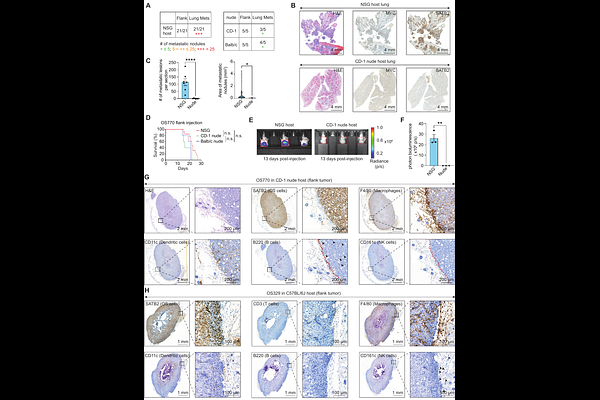
AbstractRampant genomic instability of osteosarcoma (OS) and associated inter- and intratumoral heterogeneity convey a high risk of metastasis despite contemporary multimodal therapy. A mouse primary OS tumor model, originating from Myc-overexpressing Trp53-null mesenchymal progenitor cells, closely mimics cardinal genetic features and gene expression patterns of human OS samples. Subcutaneous injection of OS cells into immunocompromised NSG mice produced extensive metastases, whereas many fewer metastases occurred in T cell-deficient nude mice, suggesting a principal role for innate immunity in controlling OS dissemination. Depletion of natural killer (NK) cells in nude mice facilitated OS metastasis. OS cells released a suite of chemokines, with CCL2 the most prominent. A genome-wide CRISPR/Cas9 screen in OS cells identified 11 genes, including Ccl2, whose loss facilitated pulmonary metastasis in nude mice. Disruption of CCL2 in OS cells partially phenocopied the effects of antibody-dependent NK cell depletion, underscoring a plausible OS-NK signaling pathway that limits OS metastasis.