N-3 Polyunsaturated Fatty Acids Ameliorate Post-infarction Cardiac Dysfunction Through Modulation Of Adiponectin-Ceramide Metabolism

N-3 Polyunsaturated Fatty Acids Ameliorate Post-infarction Cardiac Dysfunction Through Modulation Of Adiponectin-Ceramide Metabolism
Liu, Y.; Sun, W.; Liu, J.; Wu, H.; Liu, P.; Chen, Y.; Zhang, R.; Chen, W.; Wang, S.; Guo, X.; Zhang, W.; Cao, L.
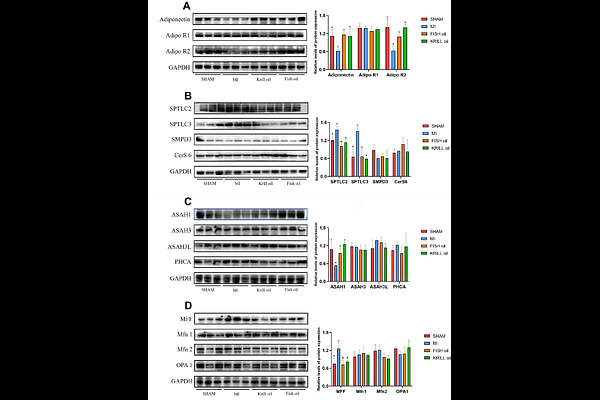
AbstractObjective:To determine whether marine-derived n-3 polyunsaturated fatty acids (PUFAs) improve post-myocardial infarction (MI) cardiac dysfunction by modulating the adiponectin-ceramide metabolic axis, and to assess potential form-specific differences between triglyceride-based (fish oil) and phospholipid-based (krill oil) n-3 PUFAs. Approach and Results: A case-control study of 100 acute MI patients and 100 healthy controls revealed significantly elevated serum C16:0-, C18:0-, C20:0-, and C24:1-ceramides in MI patients, which correlated inversely with left ventricular ejection fraction. In a murine MI model, four-week dietary intervention with fish oil or krill oil significantly reduced myocardial infarct size and improved ejection fraction compared to vehicle controls, with no significant difference between the two n-3 PUFA forms. Targeted lipidomics demonstrated that both interventions markedly reduced cardiac and serum levels of pathogenic long-chain ceramides. Mechanistically, n-3 PUFA supplementation upregulated myocardial adiponectin and AdipoR2 expression, suppressed de novo ceramide synthesis via downregulation of SPTLC2/3, and enhanced ceramide catabolism through ASAH1 activation. These changes restored mitochondrial dynamics, attenuated MFF-mediated fission, and suppressed p53- and caspase-3-dependent cardiomyocyte apoptosis. Conclusion: n-3 PUFAs exert cardioprotective effects post-MI by activating the adiponectin-ceramide axis, restoring mitochondrial homeostasis, and inhibiting apoptosis, independent of their triglyceride or phospholipid carrier form.