R-Ras coordinates reciprocal activation of ERK5 and ERK1/2 under single pathway inhibition in melanoma

R-Ras coordinates reciprocal activation of ERK5 and ERK1/2 under single pathway inhibition in melanoma
Tusa, I.; Mazzei, C.; Papini, D.; Menconi, A.; Sfragano, Y.; Tubita, A.; Montemurro, G.; Penitenti, J.; Esparis-Ogando, A.; Pandiella-Alonso, A.; Rovida, E.
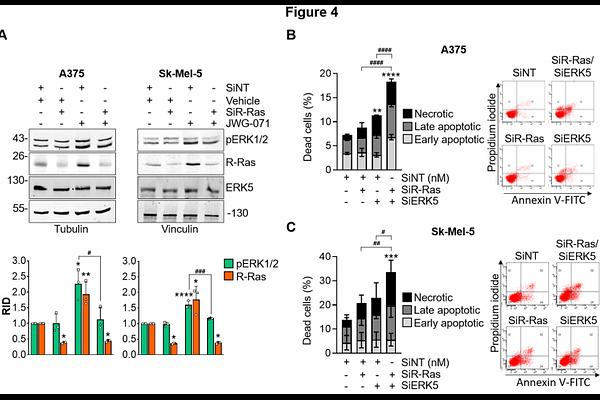
AbstractMalignant melanoma is an aggressive cancer driven by aberrant Mitogen Activated Protein Kinase (MAPK) signaling. Although BRAF and MEK1/2 inhibitors improved the outcome in patients with BRAF mutations, resistance frequently arises. Accumulating evidence at the preclinical level has identified the activation of the MEK5/ERK5 pathway among the mechanisms sustaining the growth in different types of cancer upon Ras-RAF-MEK1/2-ERK1/2 pathway inhibition. On the other hand, there is a lack of information concerning the effect of ERK5 inhibition on the RAF-MEK1/2-ERK1/2 pathway in melanoma. Here, we report that both genetic and pharmacological inhibition of ERK5 leads to hyperactivation of the MEK1/2-ERK1/2 cascade in BRAFV600E-mutated melanoma cells. Starting from available transcriptomic data showing that ERK5 knockdown increases the mRNA levels of the Ras-Related Protein R-Ras, we identified R-Ras as a key mediator of ERK1/2 activation upon ERK5 inhibition. Indeed, R-Ras silencing prevented ERK1/2 hyperactivation and potentiated the anti-proliferative and pro-apoptotic effects of ERK5 inhibition. Intriguingly, R-Ras knockdown impaired the increase of ERK5 phosphorylation observed in response to BRAF-MEK1/2-ERK1/2 inhibition and enhanced apoptosis induced by the latter. Constitutively active R-Ras mutant promoted ERK5 phosphorylation/activation, positioning R-Ras upstream of ERK5. Pharmacological inhibition of Ras with the pan-Ras inhibitor RMC-6236 reduced melanoma cell viability and potentiated the tumor suppression activity of either ERK5 or BRAF-MEK1/2-ERK1/2 inhibitors, in both 2D and 3D tumor models. Collectively, our findings identify R-Ras as a critical regulator of the bidirectional crosstalk between ERK1/2 and ERK5 pathways, supporting its potential as a therapeutic target to overcome adaptive resistance in BRAFV600E-mutant melanoma.