Thermoadaptation of EndoG proteins in the Xenopus frog genus

Thermoadaptation of EndoG proteins in the Xenopus frog genus
Tokmakov, A. A.
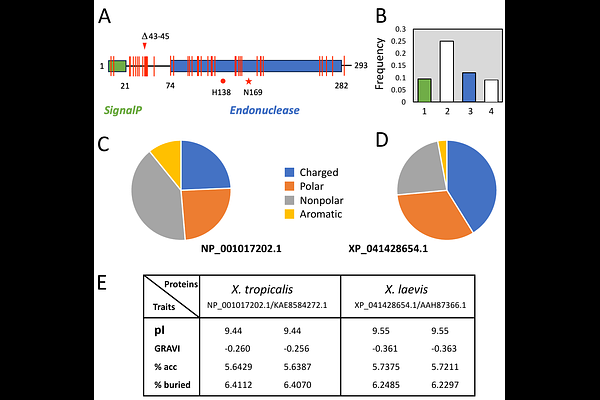
AbstractXenopus is a genus of entirely aquatic frogs found in sub-Saharan Africa. Currently, the complete genomes of two species within the Xenopus genus, Xenopus laevis and Xenopus tropicalis, have been fully sequenced, annotated, and made publicly available. The two species inhabit markedly different environments: X. tropicalis lives in the hot, equatorial regions of Africa, whereas X. laevis resides in the cooler climates of southern Africa. In the present study, mutational profiling, comparative homology modeling, and computational bioinformatics were used to identify the features of adaptive evolution in Xenopus endonuclease G (EndoG) proteins. The multiple characteristics of EndoG isozymes were discovered to vary considerably between the two Xenopus species dwelling in different locations. Most notably, EndoG proteins from the psychrophilic X. laevis exhibit the increased contents of charged and polar residues, elevated pI, higher intramolecular interaction energies, B factors, molecular void volumes, and solvent accessibilities, but the decreased contents of nonpolar and aromatic amino acids, lower hydrophobicity, buried surface area, and molecular packing density compared to those from the thermophilic X. tropicalis. The observed differences strongly suggest that temperature plays a dominant role in EndoG diversification. Evaluation of intramolecular interaction energies appears to be a particularly sensitive and discriminative framework for assessing protein divergence at the structural level. Overall, this study highlights the diversification of homologous proteins in ectothermic vertebrate eukaryotes and provides mechanistic insight into protein adaptation to contrasting environments.