Metabolic engineering of Escherichia coli to modulate hydrogen sulfide levels in the mammalian gut

Metabolic engineering of Escherichia coli to modulate hydrogen sulfide levels in the mammalian gut
Hayes, J. A.; Buchinger, B.; Lunger, A. W.; Khanvilkar, T.; Gasparrini, W.; Fernez, M. T.; Morrissette, M.; Strandwitz, P.; Koppes, A. N.; Koppes, R.; Woolston, B. M.
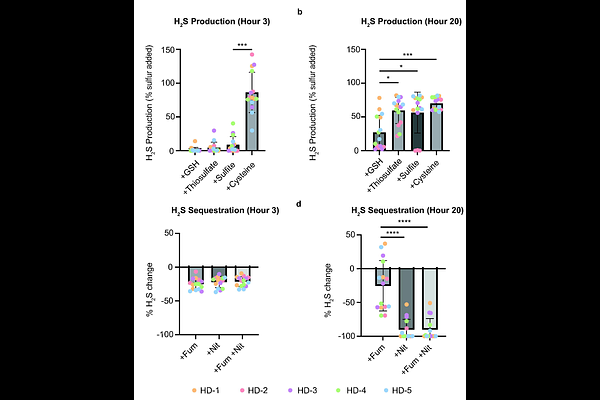
AbstractHydrogen sulfide (H2S) is a microbiota-derived metabolite in the gastrointestinal tract implicated in a number of diseases. Its volatility and reactivity make experimentally controlling H2S concentration in vivo difficult, limiting our ability to interrogate its dose-dependent effects on host physiology. Engineered bacteria present a compelling solution, yet most probiotic metabolic engineering approaches have focused on in vitro optimization, failing to account for the complex intestinal environment. Here, we engineered Escherichia coli strains to produce or consume H2S in specific intestinal regions by incorporating knowledge of the local metabolic environment and resident microbial activities into the design process. Analysis of human-derived ex vivo cultures revealed that glutathione (GSH) is inefficiently converted to H2S, suggesting GSH as a relatively stable substrate for engineered sulfide production. We thus engineered a GSH-dependent H2S producer, which increased levels 21-fold ex vivo. To target the nutrient-rich, microbially sparse environment of the small intestine, we optimized a H2S producer that uses L-cysteine as a sulfur source, demonstrating a 7-fold increase in H2S levels in mice. Finally, to develop strains capable of sequestering H2S, we leveraged the availability of fumarate and nitrate as electron acceptors in the large intestine by engineering a strain expressing sulfide:quinone oxidoreductase (Sqr). This enables oxidation of H2S to intracellular polysulfides and achieves higher consumption rates than alternative sequestration strategies reliant on resource-intensive GSH production. Together, this work developed engineered microbes as precision tools to modulate H2S levels and showcases a generalizable framework for region-targeted design of engineered probiotics.