ProtSyntax: a protein large language model for decoding post-translational modification syntax and function

ProtSyntax: a protein large language model for decoding post-translational modification syntax and function
Lin, Y.
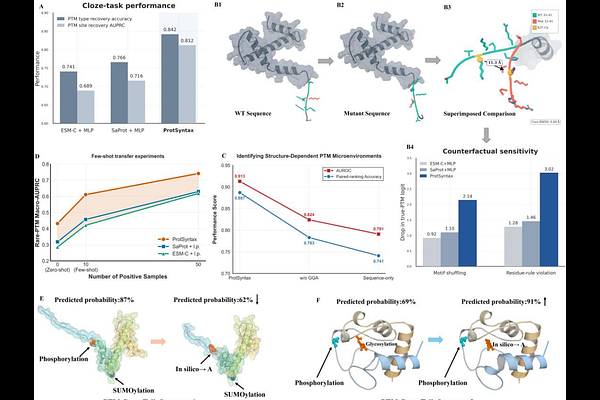
AbstractPost-translational modifications (PTMs) regulate protein function through dependencies among residue chemistry, sequence context, three-dimensional microenvironments and modification states, yet most predictors model sites independently and do not connect modification propensity to functional consequences. Here we present ProtSyntax, a PTM-centered protein language model trained on 4.25 million examples spanning 40 PTM classes and supervised for kinase specificity, PTM crosstalk and enzyme kinetics. ProtSyntax integrates bidirectional long-range modeling with geometry-gated attention in a sparse mixture-of-experts architecture and uses adaptive multi-objective learning to couple residue-level PTM syntax to protein-level function. Across 40 PTM-site benchmarks, ProtSyntax improved mean MCC and AP by 12.7% and 10.7%, respectively, relative to the best-performing baselines. It also distinguished authentic sites from structurally incompatible motif decoys, transferred to rare PTMs, recovered crosstalk, linked PTM perturbations to enzyme-kinetic changes and identified disease-associated PTM disruptions. Together, ProtSyntax provides an interpretable framework for decoding PTM regulation across the proteome.