Modelling phenotypic plasticity in cancer invasion and metastasis: from microscopic interactions to macroscopic dynamics

Modelling phenotypic plasticity in cancer invasion and metastasis: from microscopic interactions to macroscopic dynamics
Katsaounis, D.; Chaplain, M. A.; Sfakianakis, N.
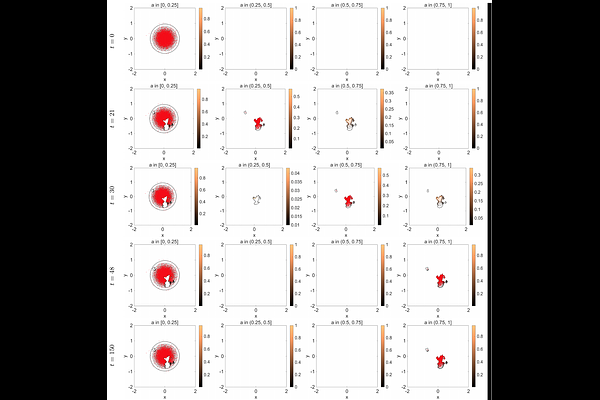
AbstractCancer progression is driven by the interplay between cancer cell phenotypic variability regulated by EMT/MET, and cell-cell and cell-matrix interactions. Starting with an individual-based model, in which every cell is characterised by its position, velocity and a continuously varying epithelial-mesenchymal phenotype, we derive, via a kinetic description and a mean-field limit, two alternative macroscopic formulations: an Euler-like system that couples mass and momentum to the phenotypic variable, and a single advection-aggregation-diffusion equation (AADE) for the cancer cell density. Both macroscopic models retain the non-local adhesion-repulsion forces, haptotactic response to an evolving ECM, and phenotype-dependent transition dynamics driven by TGF-beta. Numerical experiments in two spatial dimensions indicate that the macroscopic equations reproduce key scenarios obtained at the individual scale. In particular, a microscopic-macroscopic comparison shows that the AADE density reproduces accurately both the spatial localisation and the phenotypic decomposition of the individual cell population. We also demonstrate that varying only the steepness of the TGF-beta switch function, changes the EMT response from an almost binary epithelial-mesenchymal (EM) separation to a partial EM phenotypes. This study provides a systematic bridge from stochastic, heterogeneous cell dynamics to continuum descriptions, for investigating phenotype driven tumour invasion and supporting the choice of macroscopic models in large-scale simulations and analytical studies.