Comprehensive dissection of GPCR signaling using a NanoBiT-based platform

Comprehensive dissection of GPCR signaling using a NanoBiT-based platform
Saito, A.; Yamaguchi, S.; Suzuki, R.; Yanagawa, M.; Kise, R.; Inoue, A.
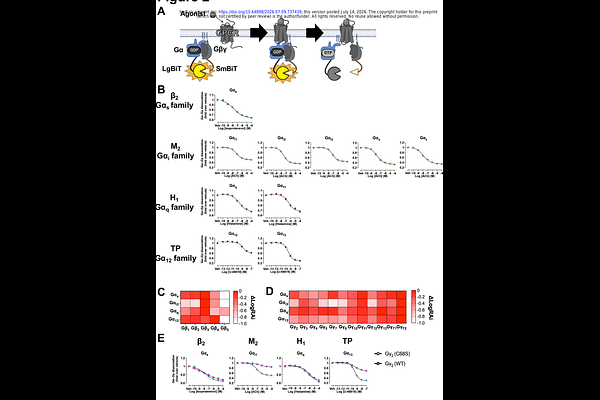
AbstractG-protein-coupled receptors (GPCRs) signal through multiple heterotrimeric G proteins, {beta}-arrestins, GPCR kinases (GRKs), and downstream effectors, whose combinatorial interactions shape cellular responses. These events are typically measured with separate assay formats that each capture only part of the network, making comparison across signaling layers difficult. Here, we consolidate a broad set of previously reported GPCR signaling interactions and assay concepts, together with newly designed sensors, into a single NanoBiT split-luciferase framework, allowing multiple layers of signal transduction to be examined side by side in living cells. We show that rational sensor engineering, in particular the positioning of NanoBiT fragments and targeted modification of the tagged proteins, is essential for detecting transient protein-protein interactions. The framework implements assays for G-protein dissociation, {beta}-arrestin recruitment, conformational activation and trafficking, and GRK recruitment, and extends to G-protein-effector and inter-effector interactions across diverse G, G{beta}, G{gamma}, {beta}-arrestin, GRK, adenylyl cyclase, PLC{beta}, and RhoGEF subtypes. It also enables real-time monitoring of the difficult-to-access G12/13-RhoGEF-RhoA pathway. Together, these assays provide a unified NanoBiT readout for systematic, side-by-side dissection of GPCR signaling.