scDisent: disentangled representation learning with causal structure for multi-omic single-cell analysis

scDisent: disentangled representation learning with causal structure for multi-omic single-cell analysis
Xi, G.
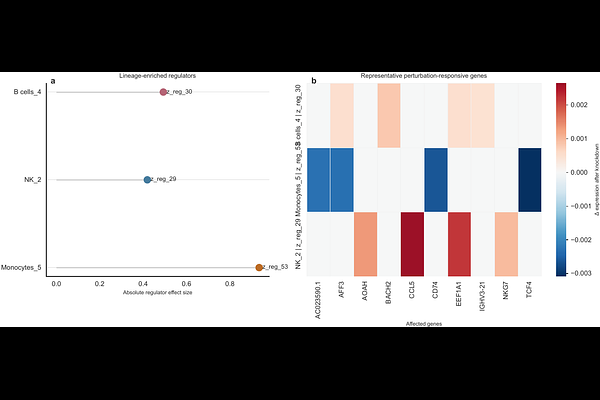
AbstractSingle-cell multi-omic technologies measure complementary aspects of cellular identity and regulatory state, yet most integration models compress these signals into one entangled latent space. Such representations are useful for clustering but poorly suited for mechanistic interpretation or perturbation-oriented analysis. We present scDisent (https://github.com/xig uoren/scDisent), a generative framework for disentangled representation learning that separates expression-associated variables (zexpr) from regulation-associated variables (zreg) and links them through a sparse directed mapping. scDisent combines modality-specific encoding, variational disentanglement with total-correlation and orthogonality constraints, and a Gumbelgated causal module protected by detach-based gradient isolation. Evaluated on benchmark datasets with matched modalities, scDisent achieved best-in-benchmark integration performance while exposing regulatory structure that competing integration methods do not model explicitly. The learned causal atlas remained sparse, perturbation analyses recovered biologically coherent lineage-associated programs, and cross-dataset discovery analyses highlighted interpretable immune, neural and developmental signatures. Quantitative branch-separation analyses further showed that benchmark-label information concentrated in zexpr rather than zreg. Together, these results position scDisent as a computational method that improves not only integration quality but also biological interpretability, making single-cell multi-omic representations better suited to biological question answering and in silico hypothesis generation.