FLT3-ITD signals for CEBPA and p53 proteolysis by the ubiquitin-proteosome pathway

FLT3-ITD signals for CEBPA and p53 proteolysis by the ubiquitin-proteosome pathway
Gu, X.; Biswas, S.; Zahran, Z. A.; Bae, S.; Balusu, R.; Jha, B. K.; Maciejewski, J. P.; Saunthararajah, Y.
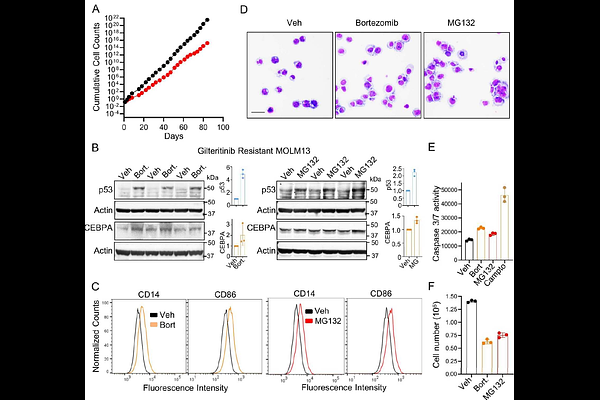
AbstractInternal-tandem-duplication of the receptor tyrosine kinase FLT3 (FLT3-ITD) generates ligand-independent signaling and is highly recurrent in acute myeloid leukemias (AMLs). One way signaling pathways can quickly influence cell fates is by phosphorylating key fate-determining proteins to trigger their proteolysis. We investigated the master transcription factor (MTF) driver of granulo-monocytic lineage-fates, CEBPA, for regulation by this mechanism because we found high CEBPA mRNA but little CEBPA protein in FLT3-ITD versus FLT3-wildtype AML cells, and inhibiting FLT3-ITD signaling with tyrosine kinase inhibitors (TKI) rapidly rescued CEBPA protein. Mass spectrometry analyses of CEBPA and its interactome demonstrated prominent interactions with major ubiquitin-proteosome pathway (UPP) components UHRF1 and USP7. TKI treatments decreased CEBPA and USP7 phosphorylations at serine 21 and serine 18 respectively alongside shifts in CEBPA interactions from degradative ubiquitin-ligase UHRF1 toward protective deubiquitinase USP7. The rescued CEBPA activated granulocytic-differentiation. Supporting that the serine-phosphorylations were phospho-degrons, UPP-inhibitors (bortezomib, MG132) increased phosphorylated and total CEBPA and USP7. The MTF regulator of apoptosis p53 is a known USP7 client, therefore, we also evaluated p53 status: TKIs and UPP-inhibitors stabilized USP7 and p53, triggering apoptosis in addition to granulocytic-differentiation specifically in FLT3-ITD but not FLT3-wildtype AML cells. UPP-inhibitors produced these consequences in TKI-resistant FLT3-ITD AML cells also. These data predicted genetic loss-of-function to CEBPA or TP53 is redundant in the FLT3-ITD context, borne out by mutual exclusivity of the mutations in clinical series. In summary, FLT3-ITD signals for CEBPA and p53 proteolysis to block lineage-maturation and apoptosis, positioning UPP-inhibitors as therapeutic candidates acting downstream of TKIs.