Diversity and evolution of the transcriptional regulatory networks of Pseudomonas strains revealed using machine learning

Diversity and evolution of the transcriptional regulatory networks of Pseudomonas strains revealed using machine learning
Bajpe, H.; Hefner, Y.; Szubin, R.; Sung, J.; Palsson, B. O.
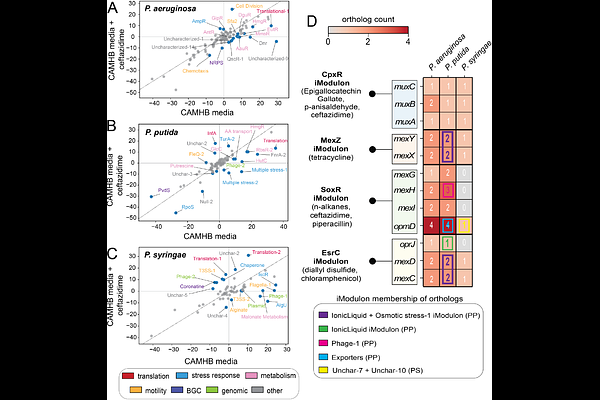
AbstractThe genus Pseudomonas consists of diverse and ecologically significant species that form close associations with both plants and animals. This genus is widely studied due to the clinically relevant Pseudomonas aeruginosa, model plant pathogen Pseudomonas syringae, and non-pathogenic, industrially relevant Pseudomonas putida. The different metabolic and physiological capabilities of these species are enabled by their unique genetic makeup as well as varying regulatory mechanisms. To study the transcriptional basis for the diversity of the three species, we applied independent component analysis to strain-specific RNA-seq datasets to identify independently modulated gene sets (iModulons) and their condition-specific activity levels. We then mapped iModulons across strains based on their similarity in orthologous gene membership. Through comparison of iModulon gene membership and activities, we find that: (i) iModulons reveal shared and unique regulatory modalities across strains; (ii) unique adaptations in common functions, such as translation and pyoverdine production/uptake, manifest through both differential iModulon gene membership and condition-specific activation states in each strain; (iii) iModulons facilitate comparison of stress responses at the systems level; and (iv) iModulons highlight unique virulence factor enrichment and host-specific adaptations in human and plant pathogens. Altogether, comparing the modularized transcriptomes of the three strains provides unique and comprehensive insights into their differential evolution.