Routine FFPE sections support clinically compatible single-nucleus transcriptomics across six human cancer types

Routine FFPE sections support clinically compatible single-nucleus transcriptomics across six human cancer types
Wouters, J.; Bertorello, J.; Gaillard, M.; Simon, B.; Gastineau, S.; Roehrig, A.; Dupont-Roc, M.; Amblard, E.; Pupo, A.; Yu, H.; Blay, J.-Y.; Guerin, C.; Nebot Bral, L.; Vincent Salomon, A.; Verlingue, L.; Xylina, E.; Cabel, L.; Ross, J.; Miller, V.; Letouze, E.; Vallot, C.
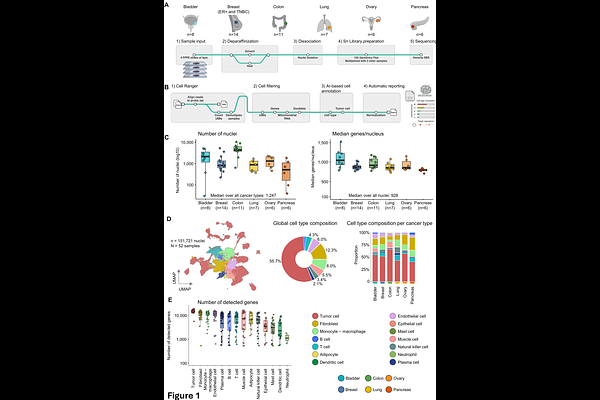
AbstractTumor cellular composition, including malignant cell states, immune populations, and stromal populations, is increasingly recognized as a determinant of therapeutic response and resistance to anti-cancer agents, yet comprehensive cellular profiling remains largely confined to research settings. Here, we present a clinically compatible sample-to-report workflow for tumor composition profiling from routine formalin-fixed paraffin-embedded (FFPE) clinical specimens. By combining low-input single-nucleus RNA sequencing with foundation model-based automated cell annotation, this workflow enables prospective sample-by-sample analysis without dedicated research material or cohort-based processing. Across 116 clinical specimens representing six cancer types, we generated reproducible measurements of cellular composition and cell-type-specific gene expression, demonstrated high technical reproducibility, and showed concordance with pathological assessment of immune infiltration. The workflow was similarly applicable to archival FFPE material and ultra-low-input biopsy specimens. Together, these findings establish a practical framework for routine single-cell profiling from standard pathology specimens and open the perspective of prospective evaluation of cellular composition as a clinical biomarker in precision oncology.