METTL3 modulates cell viability and motility in HCC1143 and MDA-MB-231 triple-negative breast cancer cells

METTL3 modulates cell viability and motility in HCC1143 and MDA-MB-231 triple-negative breast cancer cells
Saglam-Sen, B.; Akcaoz-Alasar, A.; Dondurur, A. B.; Yildiz, E.; Gurer-Er, D. C.; Akgul, B.
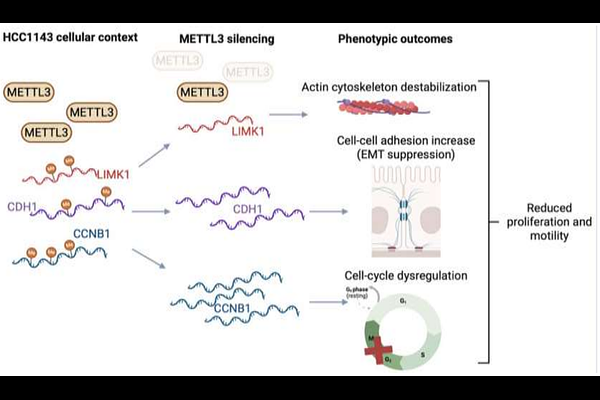
AbstractThe m6A methyltransferase METTL3 functions as a critical oncogenic driver in triple-negative breast cancer (TNBC). However, its specific downstream targets and mechanistic functions in less metastatic TNBC subtypes remain poorly characterized. To address this, we evaluated METTL3 expression and the phenotypic effects of its siRNA-mediated knockdown in normal mammary epithelial (MCF10A), low-metastatic TNBC (HCC1143), and high-metastatic TNBC (MDA-MB-231) cell lines. We assessed global m6A levels, cell viability, cell cycle progression, and migration. To uncover specific downstream pathways, transcriptomic profiling was performed on HCC1143 cells, followed by RT-qPCR validation and m6A site prediction. METTL3 depletion reduced global m6A levels and cell viability across all cell lines. Notably, in low-metastatic HCC1143 cells, METTL3 knockdown induced a pronounced G2/M cell cycle arrest and dramatically impaired migratory capacity. Transcriptomic analysis of HCC1143 revealed altered expression of genes associated with the observed phenotypic changes. Specifically, critical transcripts harboring predicted m6A motifs, including LIMK1, CCNB2, and CDH1, were significantly dysregulated, pointing to potential alterations in pathways governing cytoskeletal remodeling, actin organization, and cell-cell adhesion. Taken together, we propose that METTL3 promotes cell viability and motility in low-metastatic TNBC by regulating key transcripts involved in cell cycle progression and actin dynamics.