Deciphering the Multiscale Morphology of Somatic Oncogenic Alterations in Hepatocellular Carcinoma

Deciphering the Multiscale Morphology of Somatic Oncogenic Alterations in Hepatocellular Carcinoma
Shen, Q.; Ngo, T.; Mazloom-Farsibaf, H.; Wong, K.; Li, L.; Bhatt, K.; Zhou, F. Y.; Chang, B.-J.; Wang, X.; Shang, Z.; Haug, J.; Borges, H. M.; FIolka, R.; Zhu, H.; Dean, K. M.
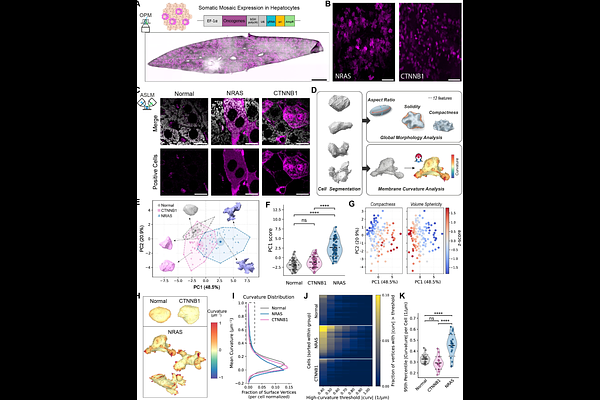
AbstractSomatic oncogenic mutations are typically defined by their molecular alterations, yet how they reorganize cellular architecture within intact tissues remain largely unknown. Here, we demonstrate that distinct oncogenic drivers produce unique multiscale architectural phenotypes that can be quantitatively resolved in intact liver tissue. Using iterative expansion microscopy, multiscale light-sheet imaging, and three-dimensional morphometric analysis, we systematically mapped structural remodeling from single-cell morphology to mitochondrial architecture in mosaic mouse models of hepatocellular oncogene activation. NRAS and CTNNB1 induced fundamentally different morphological programs. NRAS activation drove extensive remodeling of cell morphology, membrane curvature, and surface irregularity, whereas CTNNB1 activation largely preserved global cell morphology while selectively altering mitochondrial organization and shape. We first established a zonation-aware reference state for interpreting oncogene-associated organelle remodeling by resolving mitochondrial differences between periportal and pericentral hepatocytes. Within this framework, CTNNB1 activation shifted mitochondrial features toward a pericentral-like state, consistent with the role of Wnt/{beta}-catenin signaling in hepatic zonation and metabolic identity. Furthermore, integrating cellular morphology, membrane geometry, and mitochondrial architecture improved discrimination of oncogenic states beyond any individual structural feature, demonstrating that mutation-specific phenotypes arise through coordinated remodeling across multiple biological scales. Together, these findings establish multiscale structural phenotyping as a framework for linking oncogenic genotype to three-dimensional cellular organization and reveal that distinct oncogenic drivers remodel different architectural compartments during liver oncogene activation.