Evolutionary origin and structural ligand mimicry by the inserted domain of alpha-integrin proteins

Evolutionary origin and structural ligand mimicry by the inserted domain of alpha-integrin proteins
Hollis, J. A.; Chan, M. C.; Malik, H. S.; Campbell, M. G.
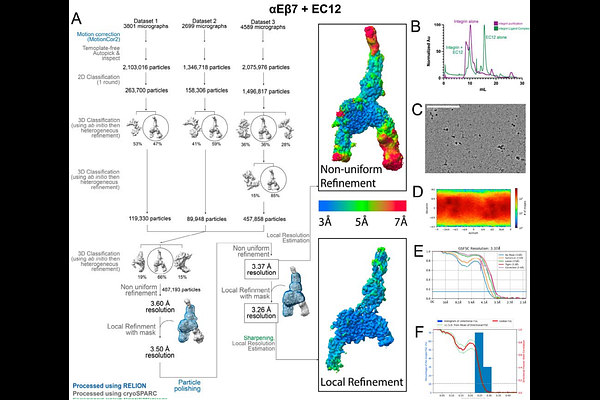
AbstractHeterodimeric integrin proteins transmit signals through conformational changes upon ligand binding between their alpha () and beta ({beta}) subunits. Early in chordate evolution, some subunits acquired an \"inserted\" (I) domain, which expanded their ligand binding capacity but simultaneously obstructed the ancestral ligand-binding pocket. While this would seemingly impede conventional ligand-mediated integrin activation, it was proposed that the I domain itself could serve both as a ligand replacement and an activation trigger. Here, we provide compelling evidence in support of this longstanding hypothesis using high-resolution cryo-electron microscopy structures of two distinct integrin complexes: the ligand-free and E-cadherin-bound states of the E{beta}7 integrin with the I domain, as well as the 4{beta}7 integrin lacking the I domain in both a ligand-free state and bound to MadCAM-1. We trace the evolutionary origin of the I domain to an ancestral collagen-collagen interaction domain. Our analyses illuminate how the I domain intrinsically mimics an extrinsic ligand, enabling integrins to undergo the canonical allosteric cascade of conformational activation and dramatically expanding the range of cellular communication mechanisms in vertebrates.