U-Probe: universal agentic probe design for imaging-based spatial-omics

U-Probe: universal agentic probe design for imaging-based spatial-omics
Zhang, Q.; Cai, H.; Zhang, J.; Zhang, L.; Wu, X.; Wei, Y.; Chen, Y.; Wu, X.; Su, W.; Qi, W.; Qiu, X.; Cao, G.; Xu, W.
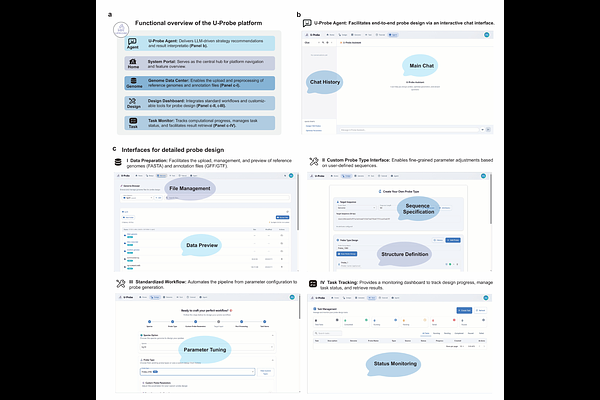
AbstractProbe design for fluorescence in situ hybridization (FISH) underpins spatial transcriptomics, three-dimensional genome studies, and clinical diagnostics, yet remains constrained by two challenges: dependence on expert knowledge for parameter selection and quality evaluation, and the inability of existing tools to accommodate the diverse probe architectures introduced by rapidly emerging methods. Here we present U-Probe, a universal and agentic probe design platform. U-Probe employs a declarative configuration system with a directed acyclic graph (DAG)-based assembly engine that supports arbitrary probe structures from established protocols such as MERFISH, seqFISH, and MiP-seq to entirely novel architectures without code modifications. Integrated LLM-based AI agents enable conversational design workflows, allowing users to specify experimental goals in natural language and receive synthesis-ready probe sequences. We validated U-Probe in three scenarios: agent-driven MiP-seq panel design for influenza-infected mouse lung tissue, genome-tiling DNA-FISH for herpesvirus detection, and a novel RCA-based ligation probe for single-nucleotide mutation discrimination. U-Probe is available as an open-source tool with CLI, Web, and agent interfaces.