CAFE: A Co-folding Approach for Fragment Exploration of Allosteric and Cryptic Binding Sites

CAFE: A Co-folding Approach for Fragment Exploration of Allosteric and Cryptic Binding Sites
Purnomo, J. C.; Sun, K.; Head-Gordon, T.
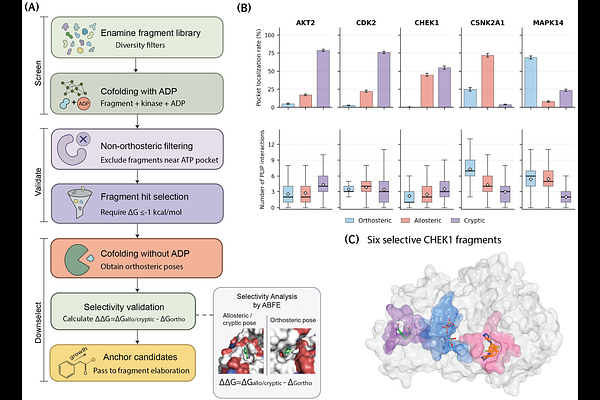
AbstractCo-folding models hold immense potential for allosteric drug discovery, but have been severely hampered by their systematic bias toward orthosteric ligand binding. While fragment screening has been proposed for allosteric binding site discovery, we show that co-folding models still suffer from memorization in which chemically simpler fragments also default to canonical orthosteric binding sites. To overcome these limitations, we introduce CAFE (Co-folding Approach for Fragment Exploration), a co-folding protocol that uses competitive orthosteric blockers to divert fragments into non-canonical sites as illustrated here with the Boltz-2 co-folding model. Using ADP as an orthosteric blocker for the kinase family, we find CAFE substantially increases the allosteric binding site exploration for fragments, with notably strong absolute binding free energies that match or exceed those of known crystallographic poses, without post-hoc refinement of the Boltz-2 prediction. We also show that CAFE identifies cryptic binding pockets undetected by conventional pocket prediction tools, some of which are more thermodynamically favorable than the allosteric or orthosteric pockets. To demonstrate generality, we apply CAFE using Type I orthosteric blockers for kinase proteins, known orthosteric ligands as blockers for non-kinase proteins in the RAS-MAPK signaling pathway, and for virtual screening campaigns using fragment libraries for new fragments that selectively engage allosteric and cryptic binding sites. CAFE establishes orthosteric blocking and fragment screening as a training-free, inference-time protocol that helps overcome some of the limitations of current co-folding models while elevating their great promise for allosteric and cryptic binding drug discovery.