Strong inhibition of insulin/IGF-1 signaling in early-mid adulthood compresses morbidity, but in later life accelerates aging

Strong inhibition of insulin/IGF-1 signaling in early-mid adulthood compresses morbidity, but in later life accelerates aging
Zhang, B.; Hsiung, K. C.; Biju, R.; Cameron-Pack, M.; Wei, X.; Chapman, H.; Kelaj, M.; Zhang, A.; Nguyen Hong, C.; Ewald, C. Y.; Gems, D.
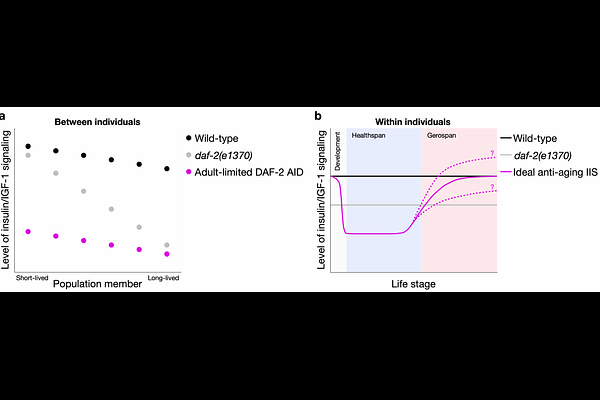
AbstractReduced insulin/IGF-1 signaling (IIS) can greatly extend lifespan in C. elegans. However, its effects on the duration of healthy life (healthspan) remain unclear, with several reports of either morbidity expansion or scaled effects, though none of morbidity compression. Moreover, life-extension by IIS reduction is particularly inter-individually variable within populations, confounding efforts to understand the intra-individual biology of such interventions. Here, we performed a longitudinal investigation at individual nematode resolution, of IIS reduction on aging-related health and lifespan, through temporally-controlled auxin-induced degradation (AID) of the DAF-2 insulin/IGF-1 receptor. Our results show how inter-individual variation in aging rate within control populations explains the complex demographic effects of age-specific DAF-2 AID on population lifespan. Strikingly, adult-limited IIS reduction causes an inter-individually homogeneous increase in lifespan (reducing Gompertz rather than {beta}) that is driven by healthspan expansion and compression of morbidity. Unexpectedly, cessation of DAF-2 AID in decrepit elderly individuals rejuvenates locomotory capacity and extends lifespan, showing that higher levels of IIS are optimal for health and survival towards the end of life. We also document a memory effect of transient IIS reduction during early adulthood, that is sufficient to fully extend lifespan (+189% median lifespan). Together, these findings demonstrate that both lifespan and healthspan can be maximized by appropriate temporal and directional modulation of IIS.