Distinct Multimodal Imaging Correlates of Depression in Middle-Aged Adults With and Without a Family History of Alzheimer Disease

Distinct Multimodal Imaging Correlates of Depression in Middle-Aged Adults With and Without a Family History of Alzheimer Disease
Duarte Abritta, B.; Abulafia, C.; Fiorentini, L.; Tafet, G.; Brusco, L. I.; Tsuchiyagaito, A.; Mathew, S. J.; Villarreal, M. F.; Guinjoan, S. M.
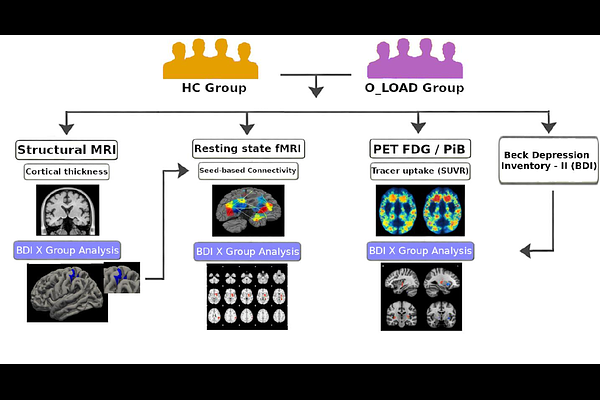
AbstractBackground: Depression is associated with risk for late-onset Alzheimer&aposs disease (LOAD), but its underlying pathogenesis in at-risk individuals remains unclear. We examined multimodal imaging correlates of depressive symptoms in cognitively normal middle-aged offspring of patients with LOAD (O-LOAD) compared with control individuals without LOAD history up to a 4th degree of kinship (HC). Methods: Participants (n=58; 52{+/-}3 years; 74% female) underwent assessment with the Beck Depression Inventory II (BDI), structural MRI, resting-state fMRI, FDG-PET, and PiB-PET. Resting state fMRI data were available for 28 O-LOAD and 24 HC; PET data for 24 O-LOAD and 22 HC. General linear models tested associations between imaging measures and BDI, including group interactions. Results: In O-LOAD, higher BDI scores were associated with reduced cortical thickness in the left postcentral gyrus. Resting-state fMRI revealed significant group by BDI interactions involving cingulate and orbitofrontal networks. In O-LOAD, greater depressive symptom severity was associated with reduced cingulate connectivity across distributed corticolimbic, prefrontal, insular, occipital, and cerebellar regions ({beta} range - 0.10 to -0.18). In HC, depressive symptoms were associated with reduced right orbitofrontal and somatosensory-medial orbitofrontal connectivity ({beta}=-0.13), with divergent patterns of cingulate connectivity. FDG-PET showed no significant associations with depressive symptoms. PiB-PET demonstrated regionally specific associations between amyloid signal and BDI in HC, involving an inverse pattern in anterior and posterior insular cortices. Conclusions: Depressive symptoms in middle-aged individuals at familial risk for LOAD are associated with distinct structural and functional alterations, involving circuitry subserving salience and reward, and suggesting early network-level mechanisms linking affective symptoms with vulnerability to neurodegeneration.