Vision Normalizing Flows for the probability-informed detection of banana diseases from in-field images

Vision Normalizing Flows for the probability-informed detection of banana diseases from in-field images
Prusokiene, A.; Prusokas, A.; Retkute, R.
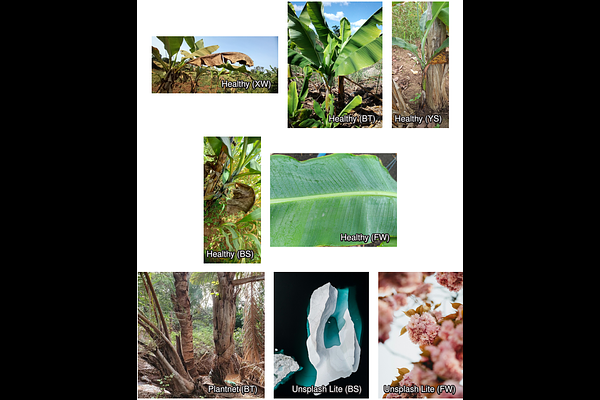
AbstractBanana diseases impose severe production losses in tropical smallholder farming systems, yet accurate in-field visual diagnosis remains difficult: symptom expression varies across cultivars and growth stages, and several diseases produce morphologically overlapping foliar signs. We developed a probabilistic image-recognition framework for detecting five economically important banana diseases - Xanthomonas Wilt, Banana Bunchy Top Disease, Fusarium Wilt (Panama disease), Yellow Sigatoka, and Black Sigatoka - from in-field photographs, without any disease-specific fine-tuning of the vision backbone. The approach extracts frozen 1,152-dimensional embeddings from the DINOv3 vision foundation model and couples them with a conditional normalizing flow, trained on four publicly available datasets spanning diseased banana plants, healthy tissue, non-banana vegetation, and general natural imagery. On an independent test set the model achieved F1 scores exceeding 0.98, average precision values of 0.968-0.999, and AUROC values of 0.997-1.0 across all five diseases evaluated as binary detection problems. Multi-class accuracy was near-perfect, with limited confusion between Yellow Sigatoka and Black Sigatoka - a biologically plausible ambiguity attributable to overlapping early-infection foliar symptoms. Because the normalizing flow estimates explicit conditional probability densities rather than decision boundaries, two complementary log-likelihood ratios can be derived: a disease ratio comparing each disease class against healthy banana, and a plant ratio comparing banana against non-banana imagery. Together these define an interpretable two-dimensional diagnostic space that simultaneously quantifies evidence for disease presence and image relevance, cleanly separating diseased plants, healthy plants, and out-of-distribution images while flagging uncertain predictions for confirmatory testing. Inference on frozen embeddings is lightweight and compatible with smartphone deployment, providing a scalable, uncertainty-aware diagnostic tool for smallholder farming systems and disease surveillance programmes.