Deciphering complete archaic introgression sequences in modern human genomes

Deciphering complete archaic introgression sequences in modern human genomes
Suo, M.; Bi, A.; Chen, Q.; Yu, D.; Jiang, L.; Liu, A.; Yang, Y.; Wang, H.; Sun, Y.; Nie, L.; Chen, R.; Yang, Q.; Wang, X.; Wang, H.; Shi, Y.; Zhang, D.; Wu, D.; Zhang, G.
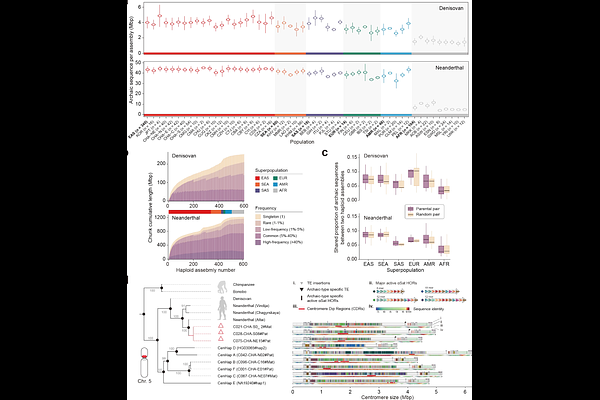
AbstractGenetic introgression from archaic hominins has profoundly reshaped the genetic diversity and adaptive potential of modern humans, yet the full catalog of introgressed sequences, particularly those residing in structurally complex regions has remained elusive. Here, we present ASMaid (ASseMbly-based archaic introgression detector), a Hidden Markov Model-based framework that leverages haplotype-resolved pangenome assemblies to identify archaic-derived sequences with unprecedented completeness. By integrating both single-nucleotide genotype and structural variation (SV) signals, ASMaid captures significantly more intact archaic segments than conventional reference-based approaches. Applying ASMaid to a global panel of 610 phased human genome assemblies, we show that non-African individuals carry approximately 79.8 Mbp of Neanderthal and 8.3 Mbp of Denisovan sequences, representing substantial increases over previous estimates, respectively. Notably, we detected several centromere-spanning archaic segments, including EAS-specific calls on chromosomes 5 and 7. Our assembly-based approach uncovered 1,701 archaic-derived SVs, revealing a previously overlooked layer of archaic functional legacy. High-frequency introgressed loci are enriched in pathways associated with metabolism, immunity, and nervous system (e.g. CTNNA2 linked to early-onset schizophrenia risk), underscoring the fundamental role of introgression in modulating modern human traits. Notably, we identified dozens of loci potentially facilitating local adaptation, such as PRDM16 involved in adipocyte differentiation and cold tolerance, and CSGALNACT2 associated with chondroitin sulfate synthesis. Furthermore, our analysis delineates three distinct Denisovan introgression pulses in Eastern Eurasian genomes, in which the first two pulses are shared across East Eurasian and Oceanian populations, while the third remain primarily exclusive in East Asians. Reflecting these complex introgression events, 31 Denisovan-derived segments, including the TBX15-WARS2 locus, are inferred to have been introduced via at least two events. This comprehensive map of archaic introgression provides a fundamental resource for understanding how ancient gene flow continuously shapes human phenotypic diversity and adaptation.