Identification of type III polyketide synthases from Ginger for dehydrogingerdione and curcumin biosynthesis by engineered Escherichia coli

Identification of type III polyketide synthases from Ginger for dehydrogingerdione and curcumin biosynthesis by engineered Escherichia coli
Pena, E. L.; Kang, S.; Gaascht, F. J.; Schmidt-Dannert, C.
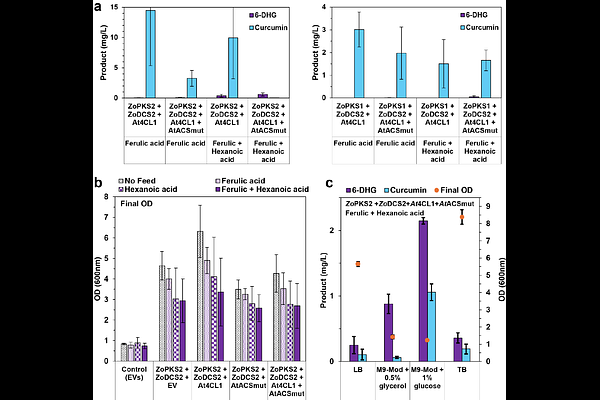
AbstractMany valuable plant metabolites are synthesized by type III polyketide synthases (PKS) that have become targets for the engineering of microbial production systems of these compounds. The rhizomes of turmeric (Curcuma longa) and ginger (Zingiber officinalis) are highly regarded for medicinal and culinary purposes and are the sources of bioactive curcuminoid and gingeroid polyketides. Fast growing demand for these compounds has sparked effort to identify their biosynthetic pathways to facilitate their heterologous production. In turmeric, a collaborative diketide synthase (DCS) and PKS (CURS) pair synthesizes curcumin from feruloyl- and malonyl-CoA. Yet, bona fide genes for the biosynthesis of gingeroids in Ginger are not known. Here we report the identification of two DCS/PKS pairs in Ginger that have different activity profiles in E. coli engineered to provide feruloyl- and hexanoyl-CoA as substrates. We show that one PKS (ZoPKS2) makes 6-dehydrogingerdione (6-DHG) as its major product while the other PKS (ZoPKS1) is a curcumin synthase. We found that ZoPKS2 becomes an efficient curcumin synthase when hexanoyl-CoA is not available, making it a dual-function enzyme that can be used to easily switch heterologous productions towards either of these two valuable products. Precursor feeding studies show that the substrate promiscuity of the collaborative DCS/PKSs may be exploited to access different dehydrogingerdione derivatives, while structural models of the Ginger PKSs offer insights for future engineering of product profiles. We believe that this work will add to the type III PKS toolbox and enable the development of efficient production platforms for gingeroids.