Fronto-Temporal Dysconnectivity and Cortical Excitability in High Schizotypy: Associations with Symptom Dimensions

Fronto-Temporal Dysconnectivity and Cortical Excitability in High Schizotypy: Associations with Symptom Dimensions
Hauke, D. J.; Iseli, G. C.; Rodriguez-Sanchez, J.; Stone, J. M.; Coynel, D.; Adams, R. A.; Schmidt, A.
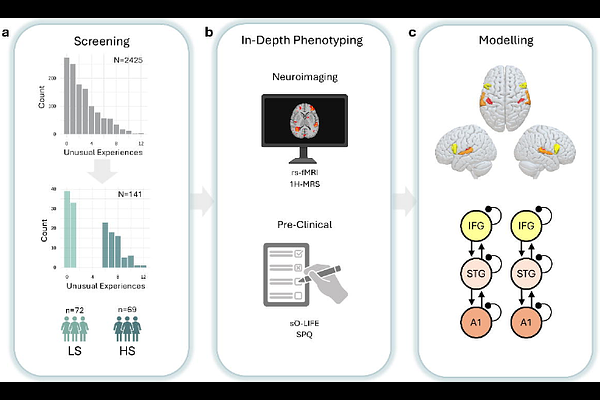
AbstractBackground: Psychosis has been conceptualised as a continuum extending from healthy individuals with psychotic-like experiences to clinical populations with schizophrenia. It is unclear which biological mechanisms found in chronic schizophrenia extend across the psychosis continuum to healthy individuals with high positive schizotypy (HS). In this study, we used computational modeling to test whether changes in effective connectivity and excitation/inhibition (E/I) balance reported in schizophrenia are also found in HS. Methods: A total of 2425 individuals from the general population were screened for HS. A subset (N=141) was invited for in-depth phenotyping. Resting-state functional magnetic resonance imaging (rsfMRI) and proton magnetic resonance spectroscopy (1H-MRS) were recorded in n=69 HS individuals and n=72 group-matched controls with low schizotypy (LS). We used dynamic causal modeling to estimate effective connectivity between bilateral primary auditory cortex (A1), superior temporal gyrus (STG), and inferior frontal gyrus (IFG). Results: Bilateral backward connectivity from IFG to STG was significantly reduced in HS compared to LS. Widespread cortical disinhibition in the auditory cortex-IFG network correlated with more severe positive schizotypy scores and impulsive nonconformity. Reduced excitability in the same network was correlated with stronger cognitive disorganisation. Conclusions: Our results favour a psychosis-continuum hypothesis, suggesting that reduced top-down drive from frontal cortex and compensatory allostatic upregulation of cortical excitability, as observed in chronic schizophrenia, also extend to groups with sub-clinical psychotic symptoms. Frontal cortex dysfunction may serve as a biologically interpretable biomarker of psychosis risk and a target for preventative interventions.