Arc Capsids Facilitate the Transfer of Muscleblind.

Arc Capsids Facilitate the Transfer of Muscleblind.
Zinter, M.; Xiao, C.; M'Angale, P. G.; Zhao-Shea, R.; Freels, T.; Tapper, A.; Thomson, T.
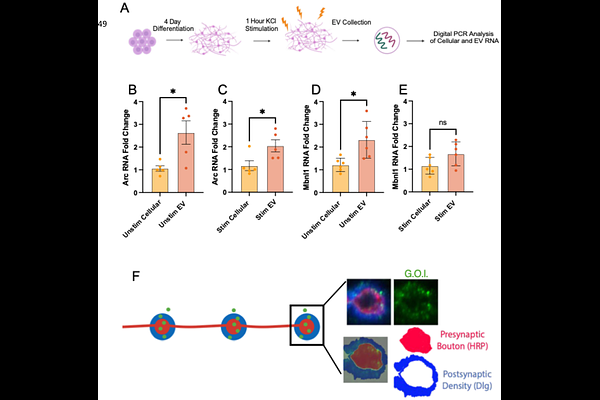
AbstractThe Drosophila activity-regulated cytoskeletal-associated protein (dArc1) can facilitate viral-like synaptic transfer of its own mRNA through dArc1 capsid formation. This transfer promotes synaptic maturation at the Drosophila neuromuscular junction and shows conservation to the mammalian neural synapse through the dArc1 mammalian ortholog, Arc. Recently, we established that dArc1 can interact with several transcripts other than its own in Drosophila including the transcript of muscleblind (Mbl), an RNA splicing factor known to be involved in neuronal and muscle development. Here, we demonstrate this interaction is further conserved to Arc and the mammalian Mbl ortholog Muscleblind Like Splicing Regulator 1 (Mbnl1). In the mouse neuro2a (N2A) cell line, immunoprecipitation of Arc protein enriches for both the Arc and Mbnl1 transcript. Upon differentiation of N2A cells, the ability of Arc to bind its own transcript and Mbnl1 are both abolished while potassium stimulation of these cells restored Arc interactions with both transcripts, indicating that this interaction is enhanced by neuronal activity. This interaction is further conserved to the mammalian central nervous system, where Mbnl1 shows increased colocalization with Arc protein in the dentate gyrus of foot-shocked mice. Furthermore, we demonstrate that both Arc and Mbnl1 RNA can be detected in extracellular vesicles (EVs), and that Mbnl1, unlike the Arc transcript, is not directly encapsulated by Arc protein. We additionally observe MblA crosses the Drosophila NMJ, likely within EVs, and postsynaptic MblA accumulation is dependent on presynaptic pools of dArc1. Taken together, our data suggest that Arc protein interacts with Mbnl1 RNA in an activity-dependent manner and this interaction may facilitate transsynaptic transfer of Mbnl1 RNA through EVs with implications for neurodevelopment.