Learning to select computations in recurrent neural circuits

Learning to select computations in recurrent neural circuits
Chen, S.; Callaway, F.; Kumar, S.; Lupkin, S. M.; Wallis, J. D.; McGinty, V. B.; Rich, E. L.; Mattar, M. G.
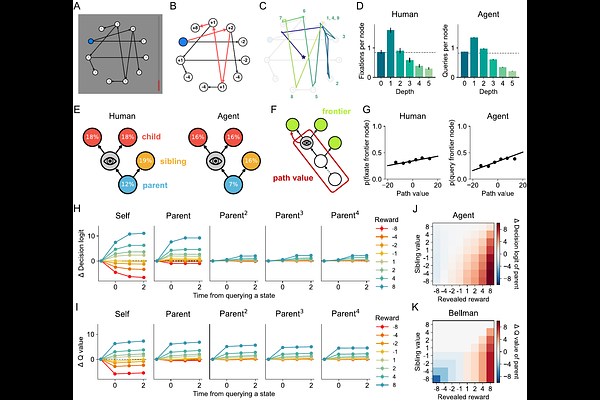
AbstractTwo hallmarks of biological computation are its flexibility and efficiency. These features are often attributed to cognitive control processes that balance external utility against computational cost. However, how the brain could implement such adaptive control remains unknown. Here, we provide one possible answer by combining the computational theory of rational meta-reasoning with a meta-learning algorithm recently proposed as a model of prefrontal cortex. This yields a recurrent neural network model that learns to select computations. In simple choice tasks, the model approximates the algorithms and representations of optimal symbolic models and reproduces neural dynamics observed in macaque orbitofrontal cortex. In multi-step planning tasks, the model replicates key behavioral signatures of human planning strategies and captures human neural dynamics associated with step-by-step mental simulation. Our framework unifies meta-reasoning and meta-learning by showing that learning to reason can be understood as learning to learn from information generated by one's own cognitive operations, providing a mechanistic account of how adaptive control of thought can be implemented in neural systems.