Spatiotemporal transcriptomics reveals distinct responses of ALDH1A1-positive and ALDH1A1-negative midbrain dopaminergic neurons to alpha-synuclein overexpression

Spatiotemporal transcriptomics reveals distinct responses of ALDH1A1-positive and ALDH1A1-negative midbrain dopaminergic neurons to alpha-synuclein overexpression
Stepek, C.-J.; Ryan, E. B.; Villegas-Salmeron, J.; New, F.; Chavda, K.; Henshall, D. C.; DiMonte, D. A.; Prehn, J. H. M.; Ulusoy, A.; Connolly, N. M. C.
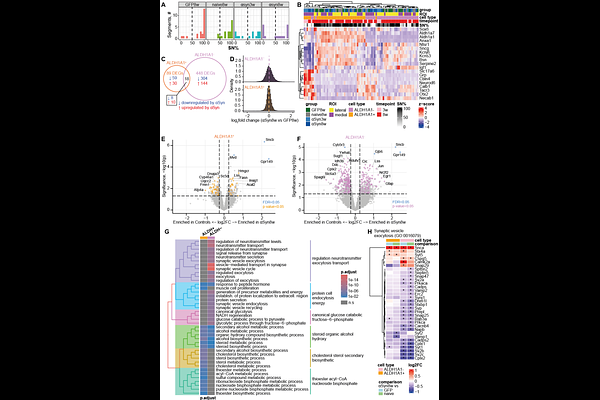
AbstractParkinson's disease is characterized by the progressive and preferential degeneration of dopaminergic neurons in the substantia nigra pars compacta, and intraneuronal alpha-synuclein (Syn) accumulation. Dopaminergic neurons (DANs) are anatomically and molecularly heterogeneous, but the impact of Syn pathology on distinct subpopulations is not well defined. One midbrain DAN sub-population expresses Aldehyde Dehydrogenase 1A1 (ALDH1A1), an enzyme that detoxifies aldehyde by-products of dopamine metabolism, and has been associated with differential vulnerability. Here, we applied GeoMx spatial transcriptomics to profile ALDH1A1-positive (ALDH1A1+) and ALDH1A1-negative (ALDH1A1-) DAN subpopulations in the mouse midbrain in situ at 3- and 8-weeks following adeno-associated virus (AAV)-mediated Syn overexpression. Analyzing 10,532 genes, we identified robust transcriptional differences between ALDH1A1+ and ALDH1A1- DANs under control conditions, supporting their characterization as distinct molecular subpopulations. In AAV-Syn-injected mice, we observed increased Snca expression and a reduction in ALDH1A1- DANs in the ipsilateral substantia nigra. Syn overexpression induced subpopulation-specific and time-dependent transcriptional responses, with dysregulation in ALDH1A1- DANs characterized by early down-regulation of pathways related to synaptic function, neurotransmitter handling, and bioenergetics, including glycolysis. In contrast, ALDH1A1+ DANs displayed later up-regulation of genes enriched for Acetyl-CoA and cholesterol metabolism pathways, reflecting subpopulation-specific adaptations to Syn overexpression. Analysis of human single nucleus RNA-sequencing data revealed partial conservation of the metabolic dysregulation signature. Together, our findings show that murine midbrain ALDH1A1+ and ALDH1A1- DANs represent molecularly distinct subpopulations with divergent temporal responses to Syn overexpression, emphasizing the importance of cell-type and disease-stage context in studies of Parkinson's disease mechanisms.