Minimizing co-growth as a broad predictor of community robustness

Minimizing co-growth as a broad predictor of community robustness
Chakraverti-Wuerthwein, M. S.; Matsubara, Y. J.; Roach, F. D.; Narla, A. V.; Hwa, T.; Murugan, A. S.
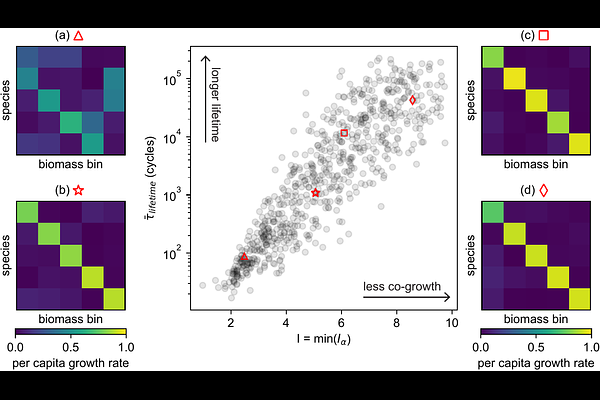
AbstractMicrobial communities rarely remain in a fixed physiological state. Instead, they progress through internal life cycles in which changing metabolites, spatial organization, and physiological states reshape ecological interactions over time. Despite extensive theory on coexistence with fixed interactions, we lack simple quantitative predictors of robustness for communities undergoing repeated growth and dispersal cycles. Here we show that a single quantity, the temporal co-growth of community members, predicts robustness across several models of community maturation, including chemotactic spatial patterning, cross-feeding with toxicity, and a phenomenological many-species model with prescribed growth trajectories. Communities in which different species grow at distinct times persist far longer under stochastic reseeding than communities with overlapping growth, with average community lifetime increasing approximately exponentially as co-growth decreases. Across the systems studied here, diverse mechanisms such as spatial organization, metabolic cascades, and physiological programs promote robustness insofar as they reduce the temporal overlap of rapid growth across species. These results identify co-growth as a common quantitative feature of robust dynamically maturing communities and suggest that minimizing co-growth may provide a broader organizing principle for ecological robustness.