A hierarchical clock-mixture model for Bayesian phylogenetic dating

A hierarchical clock-mixture model for Bayesian phylogenetic dating
Xu, Y.; Douglas, J.; Bouckaert, R.; Drummond, A. J.
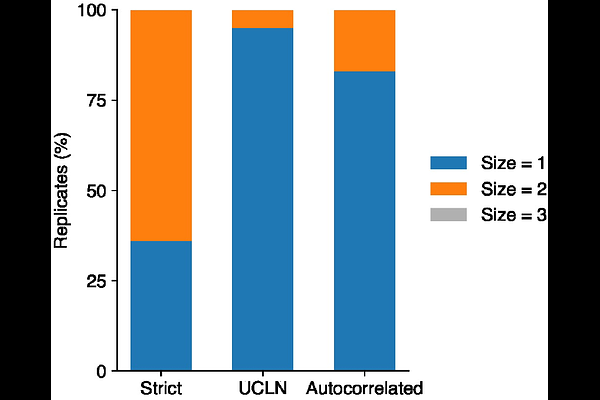
AbstractConditioning the inference of a Bayesian phylogenetic time tree on a single molecular clock model treats clock choice as fixed, even when support among plausible clock families is uncertain. When that assumption is wrong, estimated timescales and their uncertainty can be distorted. Existing practice usually addresses this by fitting strict, uncorrelated lognormal relaxed (UCLN), and autocorrelated clocks separately and comparing their marginal likelihoods, but this requires multiple computationally expensive model selection analyses.Here we introduce a hierarchical clock-mixture framework, implemented as the open-source \texttt{RelaxClockAveraging} package for BEAST~2, that separates two questions that are often conflated in clock comparison: whether branch-specific rate variation is needed at all, and, if it is, whether that variation is better described as uncorrelated or autocorrelated. The method averages analytically between strict and relaxed clocks at the top level and then compares UCLN and autocorrelated models within the relaxed class on a shared branch-rate vector, returning posterior probabilities for all three clock families together with model-averaged summaries for parameters shared across them. In stratified simulations, the generating clock family was retained in the 95\% posterior model set in all replicates, while model-averaged estimates of the overall substitution rate, root age, and tree length remained accurate. On a DENV-4 benchmark, the mixture reproduced the higher-effort nested-sampling ranking of clock families while avoiding the extreme run-to-run variability of independent marginal-likelihood estimates. On empirical benchmarks, the method recovered strong support for the autocorrelated clock on the classical 31-taxon chloroplast \textit{rbcL} data set. On an RSV-A G-gene data set it concentrated virtually all posterior support on UCLN while preserving the established RSV-A timescale. On a 245-taxon structured-coalescent H3N2 dataset it assigned most posterior mass to the relaxed-clock class, with support within that class concentrated on the autocorrelated family, and the inferred timescale remained consistent with the published estimate. These results show that clock-model support and downstream timescale sensitivity are related but not identical. Single-clock dating analyses can still be adequate, but fixing a clock model should be justified by posterior support rather than treated as a default assumption.