Developmental stage-dependent decoupling of molecular and phenotypic responses to heat in wheat grain

Developmental stage-dependent decoupling of molecular and phenotypic responses to heat in wheat grain
Masoomi-Aladizgeh, F.; Ashhurst, T. M.; Quek, L.-E.; Asar, Y.; Moore, C. L.; Lee, S.; Bokshi, A. I.; Johnson, E.; Dowland, S.; Wood, M. L.; Begcy, K.; Crossett, B.; Khoddami, A.; Trethowan, R.; Tan, D. K. Y.; Atwell, B. J.; Roberts, T. H.
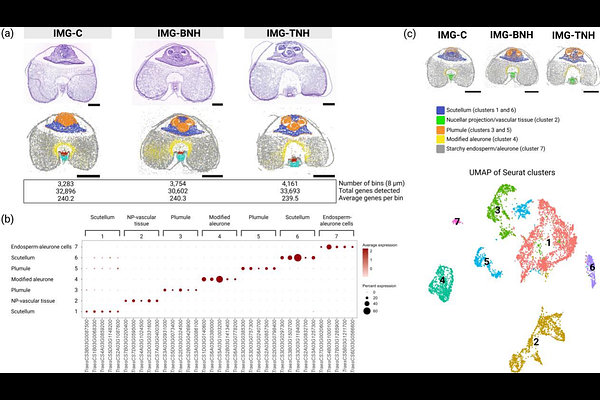
AbstractHeatwaves during flowering and grain development threaten global wheat production, yet the extent to which developmental stage shapes molecular and phenotypic responses remains unclear. Here, we investigated whether heat stress imposed at closely spaced developmental stages surrounding anthesis generates stage-specific molecular responses that are associated with subsequent effects on grain properties. Heat exposure increased floret abortion most strongly when it was imposed at the trinucleate stage (TN; ~48%) compared with the binucleate (BN) and early post-anthesis stages. Methylation levels were largely unaffected by prior heat treatments; however, heat induced stage- and locus-specific methylation changes, particularly at BN. Spatial RNA-seq revealed tissue-specific heat responses that were distinctively different in BN and TN. Integrated metabolomic analyses revealed stage-dependent metabolic reprogramming, including shifts towards stress-associated pathways. Despite heat stress at BN generating broader molecular reprogramming in developing grain, exposure at TN produced stronger effects on grain set and composition, revealing a decoupling between the magnitude of responses and phenotypic outcomes. Together, these findings demonstrate that subtle differences in developmental stage influence the complex molecular responses to heat and subsequent grain properties.