Autophagy prevents ER stress-induced Tight Junction barrier disruption via claudin-2 homeostasis

Autophagy prevents ER stress-induced Tight Junction barrier disruption via claudin-2 homeostasis
Arumugam, P.; Saha, K.; Subramenium Ganapathy, A.; Wang, A.; Harris, L.; Yochum, G.; Nighot, P.
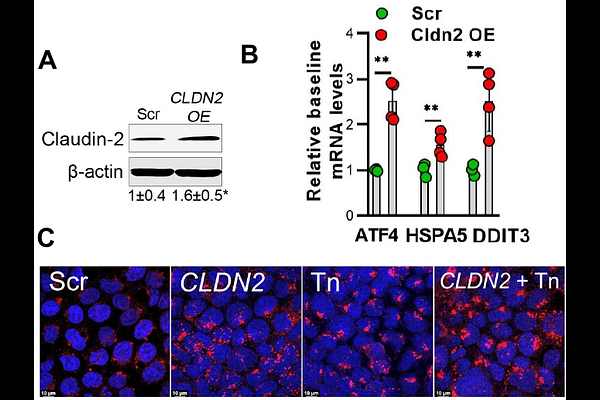
AbstractDefective intestinal epithelial tight junction (TJ) barrier function and endoplasmic reticulum (ER) stress are central pathological features of inflammatory bowel disease (IBD), yet the molecular mechanisms ER stress to TJ disruption remains poorly understood. Here, we investigated the role of autophagy in regulating intestinal TJ homeostasis during ER stress. ER stress was elevated in inflamed Crohn disease tissue and chronic dextran sulfate sodium (DSS) colitis. In human intestinal epithelial Caco-2 monolayers, murine colon, and human colonic explants, induction of ER stress with tunicamycin, thapsigargin, or brefeldin A disrupted TJ barrier integrity, as demonstrated by reduced transepithelial electrical resistance and increased paracellular permeability. ER stress selectively increased the pore-forming TJ protein claudin-2 and altered occludin localization without significantly affecting other claudins. Pharmacologic activation of autophagy with rapamycin attenuated ER stress, restored TJ barrier function, reduced claudin-2 accumulation, and preserved occludin localization. Conversely, CRISPR-Cas9-mediated deletion of autophagy gene ATG7 exacerbated ER stress, apoptosis, and TJ barrier dysfunction in vitro, while intestinal epithelial-specific Atg7 knockout mice exhibited enhanced ER stress-induced intestinal permeability in-vivo. Mechanistically, prolonged ER stress impaired autophagic flux through IRE1 kinase signaling, resulting in accumulation of p62 and claudin-2. Inhibition of IRE1 kinase activity restored autophagy, reduced claudin-2 levels, and preserved TJ barrier function. We further identified adaptor-associated kinase 1 (AAK1) as a downstream mediator of IRE1 signaling during ER stress, with increased AP2M1 phosphorylation and altered claudin-2 trafficking. Claudin-2 overexpression alone induced ER stress and lysosomal damage, suggesting a feed-forward mechanism amplifying epithelial injury. Finally, enteric rapamycin administration reduced ER stress and restored autophagy in murine DSS colitis. Collectively, these findings identify an IRE1-AAK1-autophagy axis as a critical regulator of intestinal TJ barrier integrity during ER stress.