Stepwise GRN co-option in the evolution of a dipteran respiratory organ

Stepwise GRN co-option in the evolution of a dipteran respiratory organ
Yang, Y.; Zhang, X.; Xu, X.; Ren, J.; Shi, L.; Jiang, Z.; Cai, T.; Zhen, Y.
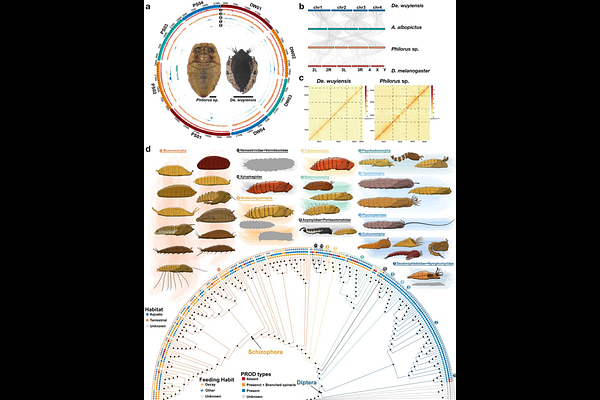
AbstractThe origin of morphological novelty lies at the heart of evolutionary biology, yet how ecological shifts drive its emergence through rewiring of gene regulatory networks (GRNs) remains poorly understood. Here, we dissect the roles of GRN co-option in the development and evolution of the prothoracic respiratory organ (PROD), a key innovation facilitating aquatic respiration in dipteran pupae. Ancestral-state reconstruction across over 200 species reveals that PROD originated ~241 Ma in the common ancestor of Diptera, with a major increase in structural complexity in schizophoran flies ~66-70 Ma. These transitions coincide with the Carnian Pluvial Episode and the K-Pg mass extinction, periods of profound climatic and ecological upheaval that likely imposed selection pressure for efficient pupal gas exchange in flooded or submerged habitats. Using comparative transcriptomics, scRNA-seq, and genetic manipulations in Drosophila melanogaster and Aedes albopictus, we demonstrate that PROD is a prothoracic wing serial homolog, specified by a cut-centered spiracle GRN and arising through heterochronic activation of an appendage GRN. In schizophoran flies, increase in complexity of PROD involved additional co-option of a breathless-centered tracheal GRN. Our findings reveal a stepwise model of hierarchical GRN co-option and provide potential links between geo-climatic events to the origin and escalation of morphological novelty. This eco-evo-devo framework provides a mechanistic and generalizable paradigm for how ecological challenges are translated into morphological innovations over macroevolutionary timescales.