Benchmarking Nanopore Sequencing for Autosomal and Y-STR profiling on R10.4.1 Flowcells across Basecalling Models

Benchmarking Nanopore Sequencing for Autosomal and Y-STR profiling on R10.4.1 Flowcells across Basecalling Models
Alsuwaidi, M. S.; Albastaki, A.; Almulla, H.; Omar, A. K.; Almarri, M. A.
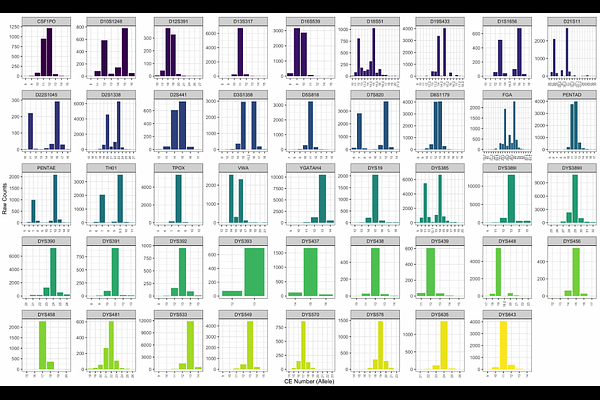
AbstractShort tandem repeat (STR) profiling is the cornerstone of forensic DNA analysis, traditionally performed via capillary electrophoresis. Recently, next generation sequencing has gained prominence due to its increased discriminatory power and enhanced performance with degraded samples. Nanopore sequencing offers a portable and cost-effective alternative, however historically high error rates have precluded its forensic adoption. Here, we evaluate R10.4.1 flow cell chemistry and multiple basecalling tiers (HAC, SUP, HYP) across several iterations (v4.2, v5.0, v5.2, v6.0) to assess their impact on genotyping accuracy. Analyzing 45 STR loci (22 autosomal and 23 Y-STRs) across single-source controls, we introduce a parallelized, user-friendly pipeline designed to transform raw POD5 files into STR profiles. Our results demonstrate a progressive improvement in genotyping accuracy with each basecalling iteration, with the latest models achieving 99.0% autosomal and 100% Y-STR concordance. Furthermore, we find that filtering on raw-read quality scores significantly improves genotyping by reducing background noise and generating cleaner profiles. Notably, the HYPv5.0 Q20 filter drove an average 53.2% reduction in misaligned reads across all loci in comparison to earlier basecalling models. Our study demonstrates that continual bioinformatic improvements in basecalling models, coupled with R10.4.1 chemistry, can provide accurate STR profiles in single-source samples, warranting larger validation studies with more diverse samples to further evaluate performance.