Identification of lipid specificity in membrane organizing protein complexes

Identification of lipid specificity in membrane organizing protein complexes
Cook, K. C.; Palacio-Rodriguez, K.; Böhlig, K.; Lennartz, H. M.; Lenz, S.; Shevchenko, A.; Honigmann, A.; Hummer, G.; Von Appen, A.; Nadler, A.
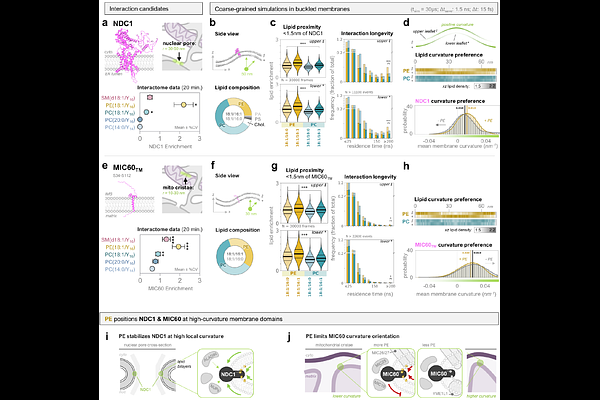
AbstractOrganelle membrane identity is encoded by protein and lipid composition. Human cells produce thousands of distinct lipid species for this purpose. Yet, the precise molecular functions of most lipids remain unknown, owing to limited methods for in situ investigations of individual lipid species. Here, we use minimally modified bifunctional lipid probes to detect and functionally characterize lipid-protein interactions across time and subcellular compartments. We leverage this approach to map time-resolved protein interactomes of individual lipids representing major membrane lipid classes as they are transported through the organelle system of human cells. We identify hundreds of unique lipid-protein interaction candidates, measure lipid-induced protein abundance changes, and distinguish between directly and indirectly interacting subunits of associated protein complexes. Informed by this multimodal dataset, we interrogate the lipid specificity of membrane organizing complexes, in particular the selective co-association of phosphatidylethanolamine with the ancestral subunits of the nuclear pore (NDC1) and MICOS (MIC60) complexes. Using super-resolution microscopy and molecular dynamics simulations, we demonstrate that phosphatidylethanolamine stabilizes both NDC1 and MIC60 in highly curved membrane nanodomains, indicating that major membrane organizing complexes are positioned by selective lipid-protein interactions. Altogether, our experimental strategy provides a blueprint for discovering and characterizing cellular functions of individual lipids.