A low-cost rpoB-based multiplex MAMA PCR for differentiation of the Klebsiella pneumoniae species complex

A low-cost rpoB-based multiplex MAMA PCR for differentiation of the Klebsiella pneumoniae species complex
Sharmin, M.; Amin, A.; Rahman, H.; Janecko, N.; Saha, S. K.; Hooda, Y.; Tanmoy, A. M.; Saha, S.
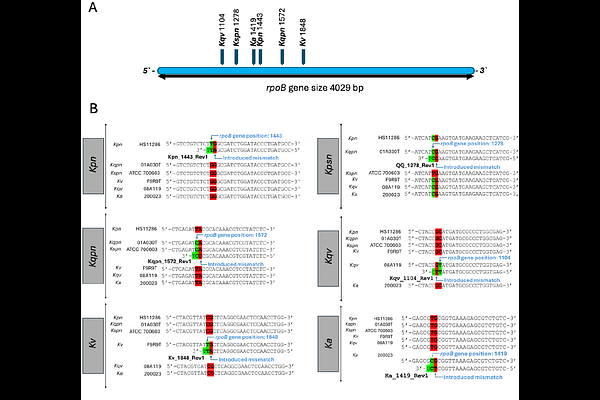
AbstractThe Klebsiella pneumoniae species complex (KpSC) is a clinically important group of closely related pathogens associated with invasive infections. The complex comprises seven closely related members, which are often reported as K. pneumoniae, particularly in resource-limited settings. Accurate differentiation of KpSC members remains challenging because routine laboratory methods lack sufficient resolution, and approaches like mass spectrometry and whole genome sequencing (WGS) are not widely available. Consequently, the epidemiology and clinical significance of non-K. pneumoniae members of the KpSC remain underrecognized. We developed a conventional multiplex mismatch amplification mutation assay (MAMA) PCR targeting species- and subspecies-specific single-nucleotide polymorphisms in the housekeeping gene rpoB, with six primer sets for differentiation of common KpSC members. The assay was validated against 49 genomically characterized clinical isolates, after which 179 wastewater-derived isolates provisionally identified as Klebsiella spp. by standard microbiological methods were tested. Of these, 174 were assigned to specific KpSC members by the assay, while 5 produced inconclusive amplification patterns. A subset of 16 environmental isolates was selected for WGS, including four of the five inconclusive isolates. All environmental isolates with interpretable MAMA PCR patterns were concordant with WGS. The four inconclusive environmental isolates were identified as Enterobacter spp. Overall, comparison of MAMA PCR with WGS showed 100% sensitivity and 100% specificity for all tested targets, and the total cost was approximately US$1. This rpoB-based multiplex MAMA PCR provides a simple, accurate, and low-cost approach for differentiation of KpSC members in routine laboratories and may support improved identification and surveillance in resource-limited settings.